Part 1
Chapter 1: The Profaned Sanctuary
The private jet descended on Toluca International Airport like a steel hawk, slicing through the thick, coppery sky above the valley. For Santiago Villarreal, the landing was the culmination of a symphony of power and success.
Behind him lay New York, the city that had surrendered at his feet, the skyscrapers of Manhattan bearing witness to a multi-billion dollar deal he had just closed.
A deal that would not only add an obscene number of zeros to his fortune but would also solidify the Villarreal empire as an unstoppable force in the global telecommunications sector. At thirty-nine, Santiago wasn’t walking on air; the world was rearranging itself beneath his feet.
As the plane taxied down the runway, he loosened the knot of his Zegna silk tie. Fatigue was a distant hum, drowned out by the adrenaline of victory. He checked his cell phone one last time: a message from his assistant confirming the transfer, an email from his legal team celebrating the win, and dozens of notifications from the financial press.
Nothing from his wife, Barbara. It wasn’t a surprise. Communication between them had become transactional, an exchange of schedules and social reminders. She managed the house and appearances; he managed the world. It was a tacit pact, efficient and as cold as the marble of his mansion in the heart of Lomas de Chapultepec.
The drive in his armored SUV was a blur of asphalt and urban chaos. The traffic on the Periférico, a monster that devoured time and patience, was merely a backdrop for his thoughts.
He was planning the weekend: dinner on Saturday at Contramar to celebrate, perhaps a getaway to his ranch in Valle de Bravo. He imagined the faces of his children, the one-year-old twins, Santiago Jr. and Valentina.
They were the only weakness he allowed himself, the only asset in his life whose value could not be quantified. They were his lineage, his legacy, living proof that his power could create life, not just absorb companies.
 As the SUV finally glided down the tree-lined, quiet streets of his exclusive neighborhood, a sense of calm began to settle over him. Here, behind high walls and electrified fences, the chaos of Mexico City faded away. This was his sanctuary, his fortress, the only place on earth where he made the rules, and no one else did.
The heavy wrought-iron gate opened with a quiet hum. The mansion’s facade, an imposing neoclassical structure with modern touches, greeted him with its usual understated grandeur. Exterior lights bathed the perfectly manicured gardens and the central fountain, whose gentle murmur was the only sound breaking the night’s silence.
May you like




He entered the house. The air inside was fresh, almost sterile. It smelled clean, of the expensive cleaning products Barbara insisted on importing, and the faint scent of the fresh flowers that adorned the foyer.
An absolute silence enveloped him. It was the silence of order, of perfection, the silence for which he paid a fortune. But that night, something about that silence felt different. It wasn’t peaceful. It was a dense, expectant silence, like the air before a storm.
She placed her leather briefcase on the mahogany table in the entryway and walked down the long hallway, her Italian shoes clicking on the marble floor.
Normally, at this hour, she would hear the distant murmur of the television in the kitchen, where the staff were finishing their work, or perhaps the soft cry of one of the twins before going to sleep. Today, nothing.
He climbed the grand, curved staircase, his hand brushing against the polished iron railing. An inexplicable unease, a tingling at the back of his neck, began to bother him.
It was a sensation foreign to him, a man whose life was based on anticipation and control. Upon reaching the second floor, he noticed the first anomaly. The door to the children’s room, their nursery , was ajar. Barbara had an unbreakable rule: that door had to remain closed to maintain the temperature and the silence.
She approached, her unease now transforming into an icy premonition. She pushed open the door, and the world stopped.
No, it didn’t stop. It shattered.
The echo of his own voice, a guttural, primal roar, resonated in the room like a gunshot. “What the hell is going on here?” The heavy wooden door, which he himself had pushed open, slammed against the wall with a fury that was not his own.
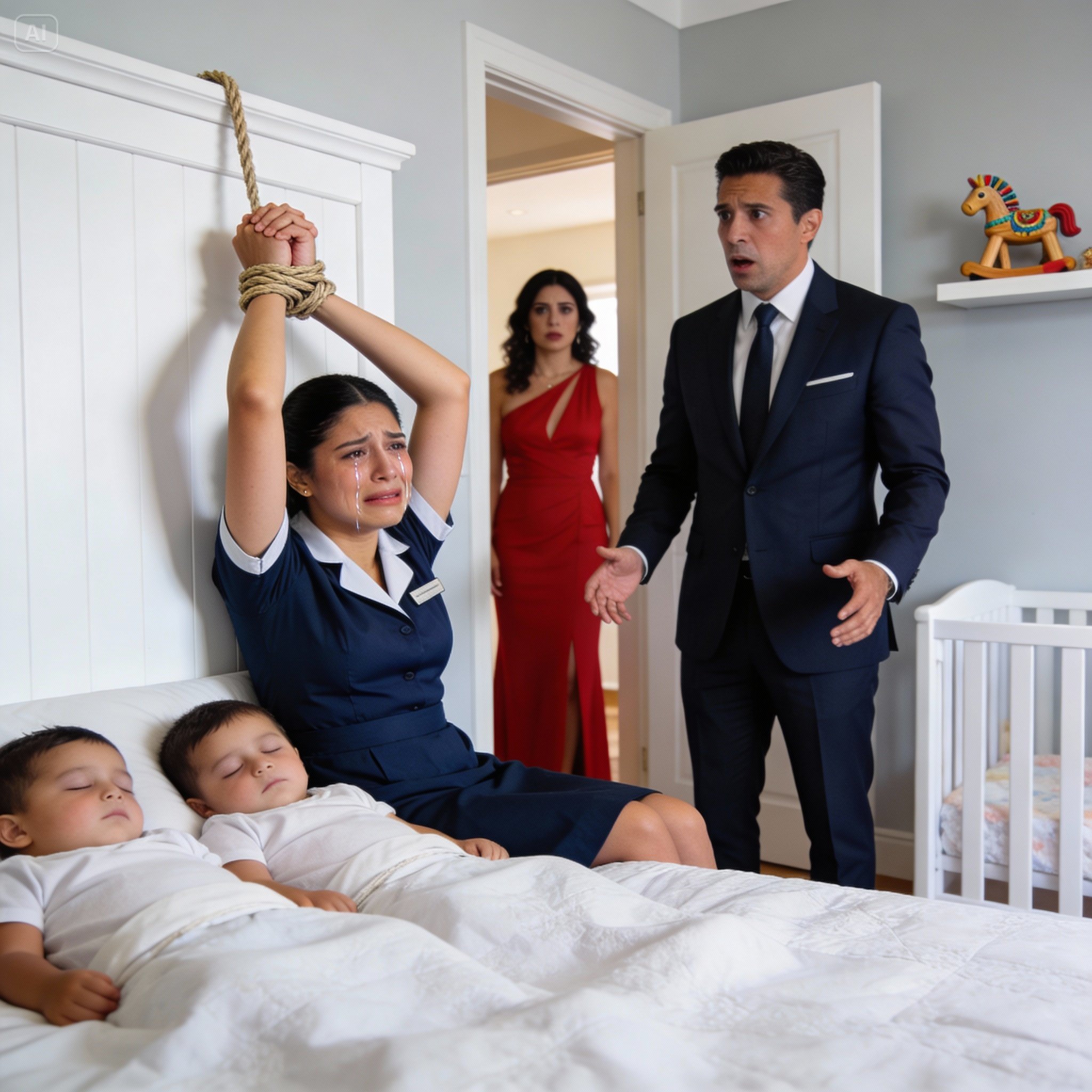
The crash, violent and alien to the peace of that room, woke the two small bundles sleeping on the chest of the woman tied to the bed.
Santiago froze in the doorway, a statue of fury and disbelief. His brain, a machine finely tuned to process data and make decisions in fractions of a second, simply shut down. He couldn’t process the scene. It was a Goya painting planted in the middle of an interior design catalog. An aberration.
Twenty-nine-year-old Sofía Ramírez was tied to the headboard. The image in his mind of her was that of a silent, almost invisible presence. A young woman from Oaxaca, soft-spoken and with meticulous movements, who cared for her children with a devotion that sometimes unsettled him.
He remembered her kneeling on the floor, teaching Santi Jr. how to stack blocks, or singing a lullaby in a strange, sweet language to Valentina until she fell asleep.
Now, that peaceful figure was broken. She was bound with strips of Egyptian linen sheets, the same ones he had chosen on a trip to Milan. The knots were brutal, the work of fury, not necessity, and had dug into the skin of her wrists until they bled. The blood, dark and thick, had stained the white fabric and Sofia’s brown skin.
Her navy blue uniform, usually immaculate, clung to her body, dark and sticky with a mixture of sweat and tears. Her black hair, which she always wore in a neat braid, was loose and plastered to her forehead and cheeks. On her chest, her one-year-old twins, her heirs, slept curled up in opposite directions. Their small fists gripped the fabric of Sofia’s blouse tightly, their faces serene amidst the desecration, as if she were the only anchor in a world that had turned violent and demented.
Sofia’s lips, swollen and with an open wound at the corner, trembled. Her voice was a fragile whisper, almost inaudible, like a dry leaf carried by the wind. “Sir, please… lower your voice. They’re finally asleep.”
The plea, so gentle amidst that brutality, was like pouring gasoline on the fire burning in Santiago’s stomach. A wave of icy, cutting fury coursed through him. Logic still failed him, but the primal instinct of the father, the protector, the alpha male whose territory had been invaded, took control.
“No,” she retorted, clenching her jaw until she felt her teeth were about to shatter. “Asleep? Asleep?! You’re tied to a bed with my children on top of you like they’re a fucking shield! What the hell happened here?!”
She dropped the briefcase she was still holding. The sharp thud of Italian leather against Carrara marble echoed with an ominous purpose. The sound made the babies stir restlessly, emitting small whimpers of protest. Despite the pain that must have been coursing through her arms, despite the terror she surely felt, Sofia reacted purely on instinct. She rocked her torso gently, an awkward movement restricted by her restraints, and began to whisper a lullaby that Santiago couldn’t understand, a broken melody that spoke of angels and moons and protective stars.
That act, that unwavering maternal instinct in the midst of horror, was the second piece of the puzzle that her mind could not put together.
His brain rebooted, working at a feverish speed. He ruled out the logical possibilities one by one.
A robbery? Impossible. The house was a fortress. Motion sensors, cameras, private guards in the gatehouse. No one entered undetected. Besides, she looked around the room. Everything was in its place. A handmade wooden rocking horse that had cost a fortune was still in its corner. The Tiffany & Co. silver toys that Barbara had insisted on buying were still on their shelf. Thieves don’t tie up the nanny and leave empty-handed.
A failed kidnapping? The idea chilled her to the bone. Had they tried to take the children? Had Sofia resisted, and that’s why they’d overpowered her? But if that were the case, where were the kidnappers?
Why would they leave the babies on top of her? Why didn’t they take them? It didn’t make sense. The logic of a kidnapping is money, the transaction. This wasn’t a transaction. This was personal, visceral.
A threat from his rivals? In the business world he inhabited, threats were commonplace. He had ruined men, destroyed companies. Had someone decided to take revenge by attacking what he loved most? But Santiago’s enemies were sophisticated. If they had wanted to harm him, they would have done so in a cleaner, more direct way. An attack on his stock, a scandal in the press. This was primitive, brutal, too chaotic to be a corporate coup.
His gaze fell on Sofia again. A new and horrifying possibility surfaced in his mind. What if it was her? What if this was a setup? A form of extortion? Perhaps she had an accomplice. Perhaps they were planning to demand a ransom.
The thought made his stomach churn. The image of Sofia, the quiet and devout young woman, was superimposed on the bound and bleeding woman before him. It didn’t add up. The expression in her eyes wasn’t one of malice, but of pure and utter terror. It was the gaze of prey, not a predator.
“Speak!” he ordered, his voice lower now, but more dangerous. “Who did this to you? Is there anyone else in the house? Answer me, damn it!”
Tears welled up again in Sofia’s eyes, silent and hot, tracing clean lines down her sweat-streaked cheeks. She shook her head, a barely perceptible movement. “There’s no one else, sir,” she whispered. “I’m alone… with them.”
“Don’t lie to me,” he hissed, approaching the bed. The smell of fear and sweat mingled with the scent of baby powder, creating a nauseating combination. He could see the cut on her lip, the torn skin around her wrists. He saw how each breath heaved in her chest, and how, despite everything, her bound hands moved instinctively to make sure the blanket covered the children.
Santiago’s rage began to shift, to transform. Blind fury was turning into a cold, lucid terror. If it hadn’t been a stranger, if it hadn’t been Sofía… only one possibility remained. A possibility so monstrous, so unthinkable, that his mind had refused to consider it.
The perpetrator wasn’t someone who had broken in. He was someone who had the key. Someone who belonged to this sanctuary.
And as if it were a sign from hell, an answer to his unformulated thought, a familiar and discordant sound came from the hallway.
The rhythmic and elegant click of stiletto heels on the marble.
A sound he knew as well as the beat of his own heart. The metronome of his life, the sound of his wife.
Barbara appeared in the doorway, silhouetted against the hallway light like a haute couture apparition. She wore a burgundy silk robe that clung to her perfect figure. In her hand, she held a freshly poured glass of red wine. Her lips, painted a flawless red, curved into a smile of studied self-assurance. Her gaze did not rest on the horror of the scene, not on the bound woman, not on her own children. It rested on Santiago, and only on Santiago.
“Oh, darling,” she said in a honeyed voice, a feigned innocence that was more chilling than any scream. “You weren’t supposed to arrive so soon.”
Chapter 2: The Metronome of Disdain
The nightmare had begun with the buzzing of a cell phone. It wasn’t hers, of course. Sofia Ramirez had been forbidden from having her phone during work hours; just one more rule in Mrs. Barbara’s endless code of conduct. It was the house phone, an extension of the main line on the nursery wall , and it rang with a high-pitched, electronic trill that always startled her.
Hours before Santiago Villarreal found her sanctuary desecrated, Sofía was waging her own silent battle. The twins, for some reason, were inconsolable. A dual, high-pitched, persistent cry had begun after their nap and nothing could stop it. She had changed their diapers, checked their temperature, offered them milk, rocked them until her own arms burned. Nothing worked. They were like two tiny, synchronized pain alarms, and the sound echoed off the hand-painted silk walls of the room, a space so luxurious and vast it seemed to mock the misery of its tiny occupants.
Sofia wept with them. Silent tears of frustration and exhaustion streamed down her cheeks as she rocked them, one in each arm, her body moving in a desperate rhythm on the expensively priced Persian rug. Her heart, however, wept not only for them. It wept for Mateo.
It had been two days since she had admitted him again to the General Hospital. A respiratory crisis, the same beast that had haunted him since birth. The doctor had told her that his small, weak lungs simply weren’t winning the battle. Each visit was a stab in the heart. Seeing her seven-year-old boy, her Mateo with his bright eyes and easy smile, connected to tubes, struggling for every breath… it tore her apart. But she had to work. The medications, the treatments not covered by public insurance, the private consultations she sought in the hope of a miracle… everything cost money. And the salary she earned in this gilded cage was the only rope keeping Mateo alive.
That’s when the phone rang.
With the babies still in her arms, she managed to press the speakerphone button. A nurse’s tired, monotonous voice filled the air.
“Villarreal family residence.”
“I am speaking about the General Hospital, pediatric area. I am looking for Mrs. Sofia Ramirez, mother of the patient Mateo Cruz Ramirez.”
Sofia’s heart stopped. The twins’ crying seemed to fade into a distant hum. “It’s me,” she said, her voice a whisper. “Did something happen? Are you okay?”
“Ma’am, the doctor asks that you come as soon as possible. Mateo’s oxygen saturation has dropped considerably in the last hour. He is unstable. The doctor says that… that it is important that you are here.”
The unspoken phrase hung in the air, heavy and sharp like a guillotine: Come and say goodbye .
“I’m on my way,” Sofia said, hanging up before the nurse could say more, before her own heart could shatter into a thousand pieces. Panic, cold and paralyzing, gripped her. She looked at the crying twins in her arms. Her job. Her responsibility. Her cage. But then she saw Mateo’s face in her mind, his big, frightened eyes searching for her. Mom .
At that precise moment, the nursery door opened.
Bárbara Montenegro de Villarreal entered the room. She didn’t enter like a mother worried by her crying children. She entered like a plantation owner inspecting her property. At thirty-eight, Bárbara was a work of art of self-discipline and aesthetics. Her body, sculpted by Pilates and starvation, was draped in a white linen ensemble. Her blonde hair, perfectly highlighted in the most expensive salon in Polanco, fell in soft waves over her shoulders. Her face, a mask of serenity maintained by Botox and fillers, betrayed no emotion.
In her hand, she held a fine crystal glass, inside which a pale, chilled Chardonnay swirled. She took a sip, her eyes assessing the scene with barely concealed disdain: the nanny kneeling, sweating, weeping, and her heirs shouting as if they were… commoners.
Her stiletto heels clicked against the marble floor. The sound was precise, rhythmic, a metronome marking the beat of her displeasure. For Sofia, that sound was the prelude to a reprimand, to humiliation. But today, she had no time for fear.
“Madam,” Sofia whispered, standing up awkwardly, the babies still clinging to her. There was a tremor in her voice, an urgency she had never before dared to show in front of the empress of that house. “Madam, please, I beg you.”
Barbara raised a perfectly plucked eyebrow. “What’s all this fuss about, Sofia? I don’t pay you and the other two a fortune to listen to this symphony of misery. Why are you crying?”
“I don’t know, ma’am, I’ve tried everything,” Sofia stammered. “But, ma’am, I need to ask you something. A favor. The biggest of my life.” She took a step closer, a movement Barbara interpreted as an invasion of her personal space, and instinctively stepped back.
“Please, just one hour. My son… he’s in the hospital again,” the words tumbled out, driven by desperation. “I just got a call from the General Hospital. They said he’s fading. That… that I need to go. Please, let me go.”
Barbara stood still, swirling the wine in her glass. The golden liquid caught the afternoon light. “Your son?” she repeated, the word sounding obscene on her lips. “That sickly child again?” Her tone wasn’t one of sympathy, but of deep annoyance, as if Sofia were telling her about a burst pipe or an insect infestation. An inconvenience.
“His name is Mateo,” Sofia said, an instinct to defend her son’s name emerging amid the panic.
“I don’t care what its name is,” Barbara interrupted. “And why should I be punished for your biological irresponsibility? Why should my peaceful afternoon be interrupted because you can’t provide for a healthy child? It’s a distraction, Sofia. And I pay you generously here so you won’t have any distractions.”
The cruelty of the words was a physical blow. But Sofia didn’t give up. Mateo needed her. “Please,” she begged, clasping her hands in a desperate prayer. The scent of chlorine and baby lotion on her hands mingled with Barbara’s expensive perfume, a collision of two worlds. “He’s all I have in the world. I swear I’ll run there and be back before he even notices. No one will be the wiser.”
“That no one will notice?” Barbara’s voice suddenly sharpened, losing its honeyed tone and becoming an icy blade. “I notice. I notice that my children, Santiago Villarreal’s heirs, never stop crying. I notice that the employee I pay three times the minimum wage can’t do her most basic job.” She moved closer to Sofia, their faces inches apart. “And on top of that, you dare ask me for favors?”
At that moment, Valentina, the younger of the twins, reached out not to her mother, Bárbara, but to Sofía, seeking comfort in the nanny’s arms. That gesture, that small act of favoritism, was the spark that ignited the powder keg. Bárbara’s smile vanished completely, replaced by a mask of icy fury. Sofía’s weakness, her dying child, was a nuisance. But her own children’s love for that woman… that was a personal affront.
Sofia swallowed hard; the lump in her throat was so painful she could barely breathe. She saw the change in the woman’s eyes. She saw the storm brewing. “I beg you, Mrs. Villarreal. For God’s sake, please. He’s my son…”
Barbara’s hand flew out. It wasn’t a shove, it was a slap. The sharp, brutal crack echoed in the room, an obscene sound muffled by the silk curtains and imported stuffed animals. Sofia’s head jerked to the side; the impact made her see stars. The burning sensation on her cheek was instant, ferocious.
“Ungrateful wretch!” Barbara hissed, her voice pure poison. “You forget your place. Do you think that just because my children tolerate you, you have any right here? You’re a cat. A servant. And in this house, cats obey.”
“Please don’t hit me,” Sofia whispered, more out of instinct than hope. Her gaze shifted to the babies, who were now crying louder, their small bodies trembling, frightened by the violence in the air, by the fury emanating from the woman who was their mother. “Not in front of them.”
Sofia’s concern for the children was the final insult to Barbara. “You’re not a mother here,” she spat, her voice trembling with rage. “Don’t you dare act like one! You’re a servant. A paid incubator. And servants don’t choose. They don’t feel. They don’t ask. They obey!”
Another slap, this time with the back of her hand. Barbara’s diamond ring, the same one Santiago had given her for their anniversary, grazed her lip, splitting it. Sofia felt her skin tear and the warm, metallic taste of blood filled her mouth, mingling with the salt of her tears.
The pain and shock made her fall to her knees. The twins, still in her arms, fell with her onto the soft carpet. Sofia managed to twist her body to break her fall. With one hand, she covered her bleeding lip. With the other, purely out of instinct, she continued stroking Santi Jr.’s back, trying to calm him.
“Please,” she whispered once more, the word now stripped of all hope, a hollow echo in the room. “Please don’t do this.”
Barbara looked down at her, panting slightly, not from exertion, but from the thrill of cruelty. A terrible and brilliant idea had just been born in her mind. A solution to all her problems: the crying children, the insubordination of the maid, her troublesome dying son.
“If you can’t stay still willingly,” she murmured, her voice now dangerously calm, “then I’ll make sure you do it by force.”
She walked with chilling calm toward the enormous cedar wardrobe. She opened it and, without hesitation, took one of the spare sheets, freshly ironed by the other maid. With surprising strength, she tore off a long strip.
Sofia watched her, paralyzed with terror. “What… what is she going to do?”
Barbara didn’t answer. She approached, grabbed Sofia by the hair, and dragged her toward the children’s bed, an Italian-designed crib that converted into a bed. “Pick up the babies,” she ordered.
Trembling, Sofia obeyed, sitting on the edge of the bed and settling the twins against her chest. Barbara pushed her back forcefully, making her lie down. The babies squealed at the sudden jolt, clinging to Sofia’s chest as if the world were collapsing.
“No, ma’am, please! I beg you!” Sofia struggled, but Barbara, fueled by resentment and two glasses of Chardonnay, possessed the strength of madness. She twisted Sofia’s arms, pulling them above her head until her shoulders screamed in pain.
“Stop!” Barbara growled, struggling with Sofia’s arms. With one knee pressed against the nanny’s stomach, she began tying the linen strips to the carved wooden headboard. She tied the first wrist, tightening the knot with a cold, methodical fury. Sofia felt the rough fabric dig into her skin.
“You’re hurting me! Please, ma’am!”
“The pain will remind you of your place,” Barbara replied, breathless. She tied the second wrist, tightening it even more. Blood began to throb beneath the bindings, an unbearable pressure. Sofia watched as the yellow cleaning gloves Barbara had forced her to wear that morning, “so as not to leave grease marks on the mirrors,” became stained with her own blood.
“Ma’am, I can’t move. This is dangerous,” Sofia gasped, panicked now. “What about the babies? What if they need something? What if I drown?”
Barbara scoffed, her laughter devoid of any joy. “Dangerous? The only danger here is a maid who forgets she’s replaceable, disposable.” With terrifying calm, she took the safety harness they used for walks in the park, an object designed for safety and care, and turned it into an instrument of torture. She fastened it around Sofia’s chest, over the babies, and tightened it until the little ones were immobilized against her, their faces pressed against her collarbone.
“You will stay here,” Barbara decreed, her voice now that of a judge pronouncing a death sentence. “You will feed them if they cry from hunger. You will soothe them if they wake up. And if necessary, you will bleed for them. That’s what I pay you for, isn’t it?”
He stepped back to admire his work. A grotesque Pietà. A martyred virgin of his own making.
“And forget about your pathetic son,” he added, bringing his face close to Sofia’s, his breath smelling of wine and malice. “He’ll probably die tonight, alone, in that horrible hospital. And you,” he said, his voice dropping to a conspiratorial and cruel whisper, “you’ll still be here, alive, rocking my family.”
Sofia’s heart didn’t break. It shattered. It turned to ashes. But through the veil of tears that blurred her vision, through the pain that screamed in her wrists and in her soul, she kept humming the lullaby. It was a melody from her grandmother, from the mountains of Oaxaca, a song about hummingbirds that carried messages of love. It was all she had left. The only thing Barbara couldn’t take from her.
“Don’t say that,” she whispered, her voice breaking with pain. “Please, don’t say that.”
Barbara bowed her head, a mock-pity expression on her face. “When my husband gets back, I’ll tell him how I found his favorite nanny lounging in bed, pretending to be a saint while neglecting the children. We’ll see how long you last here after that.”
She left the room. Sofia heard the soft click of the door closing. And then, the unmistakable sound of the key turning in the lock from outside.
I was trapped.
The hours dragged on, each minute an eternity. The pain in her wrists went from sharp to a dull, stabbing fire. Her hands went numb. Her back screamed from the unnatural position. The babies woke up, cried, and she, tied up and helpless, calmed them with her voice, with the gentle movement of her torso, with the warmth of her battered body. Finally, exhausted, they fell back asleep.
Her mind, freed from the need to soothe them, soared. It soared above the mansion walls, above the polluted city, to a bed in a public hospital. She saw Mateo. She saw his small chest rising and falling with difficulty. S
he saw his eyes searching the doorway. Waiting for her. ” Mom, where are you? You said you’d come .” Guilt choked her, a poison more potent than Barbara’s. She had failed her. Her only child was dying, and here she was, tied to the bed of someone else’s children, the woman who had condemned her.
She prayed. Broken, desperate prayers to a God who seemed to have forgotten her. She begged Him to take care of Mateo, to tell him that she loved him, to forgive him for not being there.
The afternoon sun faded, bathing the luxurious room in shades of orange and purple. Then came darkness. Only the small moon-shaped lamp in the corner cast a dim light. Time lost all meaning. Was it eight o’clock? Ten? Midnight? Her body was a map of pain. Her heart was a desert.
And then, a sound.
A sound that cut through the stillness of the night. The whir of the electric gate opening. The crunch of a heavy truck’s tires on the gravel driveway.
Santiago.
A chilling terror, different from the one she felt for Barbara, gripped her. Would he believe his wife? Would he fire her? Would he throw her out onto the street, broken and penniless? The image Barbara had promised to paint of her, that of a lazy and negligent maid, formed in her mind. It was the word of an employee against that of the lady of the house. She knew who would win.
He heard the sound of the key in the front lock. The firm footsteps on the marble below. The footsteps climbing the stairs.
His heart pounded against his ribs, a wild drum. Footsteps stopped outside the door. A silence fell that lasted an eternity.
And then, the door opened.
Chapter 3: A Father’s Verdict
Santiago’s question hung in the stale air of the room, a question that didn’t seek information, but demanded a confession. “So who?” His voice, a low, dangerous growl, was that of a predator cornering its prey.
And then, as if it were the macabre answer to an invocation, the sound came from the hallway.
The rhythmic, familiar, and elegant click of stiletto heels on marble. Click. Clack. Click. Clack. A sound that at any other time would have signified order, the arrival of the lady of the house. That night, it sounded like the advance of an executioner.
Barbara appeared in the doorway, silhouetted against the hallway light like a model from a fashion magazine. Her burgundy silk robe clung to her slender figure, and in her hand, she held a freshly poured glass of red wine, a dark, blood-red ruby. Her lips, painted a flawless red, curved into a smile of studied self-importance, a masterpiece of condescension. Her cold, blue eyes didn’t rest on the bound and bleeding woman, nor on her own children sleeping on the victim’s chest. Her gaze was fixed on Santiago, and only on Santiago, with a mixture of defiance and feigned coquetry.
“Oh, darling,” she cooed, her voice syrupy, a parody of the doting wife. “You weren’t supposed to arrive so soon. I wanted everything to be perfect for your return.”
For a split second, Santiago’s brain tried to cling to logic, to innocence. Perhaps she had just arrived. Perhaps she found Sofía like that and didn’t know what to do. But the smile on her lips, the glass of wine in her hand, the utter lack of surprise or alarm in her demeanor… it was all a confession. She wasn’t a witness. She was the perpetrator.
Santiago’s head snapped toward her, the movement so violent he felt a tug on his neck. The world seemed to shrink, collapsing into that small space: a disbelieving husband, a monstrous wife, a terrified victim, and two babies trapped at the epicenter of an emotional earthquake.
“Barbara?” Her voice was barely a whisper of disbelief. “What’s going on here?”
She raised an eyebrow; her performance was award-worthy. She moved into the room with calculated grace, her hips swaying with the confidence of someone who knows the stage is hers. She placed her wine glass on the mahogany dresser, next to a designer teddy bear.
“Exactly what it sounds like, my love,” she said, her tone light, almost amused. “I found her lounging around. In bed! With the babies crying their eyes out in their cribs. Can you believe the nerve?” She paused dramatically, running a finger along the rim of her glass, letting her venomous words settle in the air. “So, I simply made sure she didn’t slip away to continue neglecting them. A little bit of discipline. She needed to understand that there are rules in this house.”
“It’s a lie!” Sofia cried from the bed. Her voice broke in a choked sob, an explosion of despair she had been holding back. “Sir, please, you have to believe me! I swear on my son!”
Santiago raised a hand, a brusque gesture to silence her, but his steely eyes, now darkened by a fury he hadn’t felt in years, remained fixed on his wife. Every word Barbara spoke was like shoveling dirt onto the grave of the woman he thought he knew.
“Did you tie her up?” she asked, her voice flat and devoid of emotion, which made her all the more dangerous. “Did you… hit her?”
Barbara shrugged. A casual, almost dismissive gesture that was more forceful than any shout. “Don’t be so dramatic, Santiago. She’s a maid. A servant. She’s paid to obey, not to throw tantrums. She doesn’t have the right to leave whenever she feels like it.” She paused, then added, with a sting of pure venom, “Especially when she was practically begging to rush to some government hospital for that sick child of hers. Honestly, I’m sick of hearing about him. It’s such a… depressing subject.”
The words, cold and sharp, fell upon Sofia like a shower of broken glass. Her head bowed, defeated, tears now streaming freely down her face, a silent torrent of pain and humiliation. “My son,” she whispered into the mattress, her voice shattered into a million pieces. “He’s dying… and he wouldn’t let me see him.”
The mention of the child, the confirmation of the cruelty, was the turning point for Santiago. He turned sharply toward Sofía, his expression now a mask of confusion and horror. “Your son?” he repeated. Sofía’s question from hours earlier echoed in his mind: You never told me you had a son.
Sofia’s chest rose and fell with ragged, painful breaths. “I didn’t want to lose this job, sir,” she gasped, the words coming out between sobs. “I need it… I need it to pay for her medicine. I thought if I worked hard, if I didn’t cause any trouble, if I was invisible… I could handle both. But she…” Her voice caught in her throat, unable to continue, unable to verbalize the monstrosity she had been subjected to.
Barbara snorted, a sound of pure impatience. “You see. He’s hiding things from you. He can’t be trusted. I told you from the beginning, Santiago, those people aren’t reliable. We have to be firm with them.” Her gaze fell on Sofia with contempt. “Look at her crying, how pathetic. Always acting like the victim. She clings to our children as if they were her own, trying to replace them with her defective one.”
It was too much. The dam of self-control that Santiago had built throughout his life, the same one that allowed him to dismantle corporations without batting an eye, burst.
“IT JUST IS!”.
Santiago’s fist, the same one that had signed multi-billion dollar contracts, slammed against the solid wooden headboard of the bed. The blow was brutal. The wood creaked. The impact made Sofia gasp in surprise and pain, and the babies, who had momentarily calmed down, woke again, their cries now sharp and full of fear.
The silence that followed was heavier than a tombstone.
Santiago stood tall, his body trembling with barely contained fury. The look he gave his wife was one of pure, icy hatred, a hatred Barbara hadn’t known he was capable of.
“How dare you?” she hissed, each word a drop of acid. “How dare you treat a human being this way… in my own home?” Her voice rose, losing control. “HOW DARE YOU ENDANGER MY CHILDREN’S SAFETY JUST TO SATISFY YOUR CRUELTY?”
Barbara’s smile finally faltered. The mask of self-assurance cracked, revealing for a moment a hint of uncertainty. “Risk? Don’t be ridiculous, Santiago. The babies are perfectly fine. They’re with her, aren’t they? That’s what we pay her for.”
Santiago’s eyes burned. “Perfectly fine?” he repeated, his voice trembling with rage. “Tied to the chest of a woman who hasn’t eaten, who hasn’t rested, who is bleeding from the knots you tied? A woman whose spirit you just tried to destroy? Do you even hear yourself? Have you completely lost your mind?”
Sofia, in an act of pure maternal instinct that transcended her own pain and terror, began to rock the babies again, humming her broken lullaby to soothe them, to protect them from the storm that had broken out around her, even as her wrists throbbed with unbearable pain.
The sight of that woman, wounded and humiliated, still caring for her children, was what finally solidified Santiago’s decision. He approached her, his shadow looming over her. His tone, when he spoke, softened for the first time, a change so abrupt it was as if the sun had risen in the midst of a hurricane.
“Sofia,” he said, his voice barely a whisper. “Tell me everything. From the beginning. Without fear. You have no reason to be afraid anymore.”
She shook her head, still paralyzed by shame and fear, a poison that would take time to disappear. “Sir, I don’t want to cause any trouble,” she whispered. “I just wanted to do my job properly…”
Santiago’s throat tightened. The simplicity of that phrase, the submission of a victim who still felt guilty, struck him harder than any accusation. He looked at Sofia’s swollen, pleading eyes, then at his children, the small babies who, despite everything, were comforted against that woman’s chest. His children trusted that abused stranger more than their own mother. The thought didn’t just strike him; it shattered him. The structure of his life, the perfect family he thought he had built, was a farce. A rotten lie sustained by his money and his wife’s cruelty.
He straightened up and turned to Barbara. His eyes were devoid of all emotion, except for a cold, absolute resolve.
“Barbara,” he said slowly, his voice trembling, not from weakness, but from a contained fury that was infinitely more terrifying than any scream. “Is this true? She begged you to let her go see her dying child and you… did… this?”
Barbara, feeling control slipping from her grasp, resorted to the only tactic left: attack. She rolled her eyes, a theatrical gesture of exasperation. “Oh, please, don’t act like a saint now, Santiago. You were the one who hired her, with your stupid ‘give a chance’ policy. You left me alone for weeks to manage everything—the house, the children, the social events—while you played businessman around the world. What did you expect? That I’d let a mere maid disrespect me under my own roof? She needed to learn her lesson! Someone has to teach these people a lesson!”
“Learn or suffer?” Santiago murmured, her words confirming the darkness in his soul.
Without another word, she turned to Sofia. With a gentleness that starkly contrasted with her fury, she began to untie the knots that bruised Sofia’s wrists. Her fingers, accustomed to the precision of keyboards and contracts, were clumsy with the twisted fabric. The knot was incredibly tight. Barbara had tied it to last, to inflict maximum pain.
Sofia winced when he pulled at the fabric, but she didn’t move away. Santiago could feel the heat of her fevered skin, see the deep, bleeding furrows the knots had left. The smell of blood and sweat was overpowering. Finally, the first knot loosened. Then the second. Sofia’s hands fell limply to her sides.
With infinite care, as if handling the most fragile object in the world, Santiago lifted the twins from Sofia’s chest, one by one, and cradled them in his arms. The warmth of their small bodies against his chest, the familiar scent of milk and talcum powder… it was the only touch of reality in that nightmare. Santi Jr. snuggled against his father’s neck. Valentina sighed and settled into the crook of his arm. They calmed down instantly.
Santiago’s eyes, however, never left his wife.
“These children,” he said softly, each word a hammer blow to the coffin of his marriage, “trusted her more than their own mother.” He paused, his gaze sweeping over Barbara’s pale, defiant face. “And now, at last, I know why.”
Barbara’s mouth opened, but for the first time that night, no words came out. The shock, the sheer disbelief at the turn of events, had left her speechless. She, who always had the last word, who always controlled the narrative, was being judged and sentenced in her own home.
Santiago took a deep breath, his gaze moving from his wife, now a stranger, to the nanny who had silently borne the weight of his absence and his spouse’s cruelty.
“This ends tonight,” he said coldly.
Then, for a moment, his gaze softened as it rested once more on Sofia. He saw her tear-stained cheeks, her bleeding lip, the red and bruised welts on her now-free wrists. He saw the mother terrified by her dying child.
“You will see your son tonight, Sofia,” he said with unwavering resolve. “Not as a servant sneaking away for a few hours, not secretly, not asking permission. You will go as a mother. As the mother who deserves to be by her son’s side in his most difficult moment. I will take you myself.”
Fresh tears, this time of gratitude and a relief so profound it was painful, welled up in Sofia’s eyes. “Thank you,” she whispered, the word barely audible. “Thank you, sir… Santiago.”
Santiago straightened up, his body a column of steel. His eyes fixed once more on his wife, who was now visibly trembling in her luxurious silk robe, not from cold, but from impotent rage.
“You wanted to break her,” she said with icy calm, her voice the sound of cracking ice. “You wanted to humiliate her, destroy her, to feel powerful.” She paused, letting the stark truth hang between them. “Instead, you’ve broken this marriage. You’ve broken this family. You’ve broken everything.”
“From this moment on, things will never be the same again. Not for you, not for this house.”
The verdict had been pronounced.
The wine glass, forgotten on the dresser, seemed to tremble. Or perhaps it was Barbara’s hand that trembled as she reached for it. The glass slipped from her fingers, fell into a silence that seemed to last a century, and shattered against the marble floor.
The sharp, crystalline sound of the breaking glass was the echo of her own world falling to pieces. The red wine spilled onto the white marble like a bloodstain.
And for the first time in eight long years, the balance of power within the impregnable Villarreal mansion had shifted. Irrevocably. Santiago supported the heirs, the personification of the future. Sofía, wounded but free, represented the truth that had finally come to light.
And Barbara, surrounded by the fragments of her cup and her life, for the first time, had absolutely nothing.
Chapter 4: The Path to Mercy
Disbelief froze on Barbara’s face, a porcelain mask about to shatter. The sound of her glass shattering against the marble was a fracture in her perfectly controlled universe. The fragments glittered on the floor like tiny diamonds from a broken crown, and the red wine slowly spread, a bloodstain defiling the pristine whiteness of her home. For the first time in eight years of a marriage that had been her greatest acquisition, Barbara found herself without her armor of power, naked before a verdict she hadn’t dictated. And the feeling was terrifying.
“You can’t be serious,” she snapped, her voice losing its composure and becoming sharp and trembling. She took a step toward Santiago, an instinctive move to close the distance, to reaffirm her territory. “Really? You’re going to let this… this cat manipulate you like this? After everything I’ve done for this family, for your image, for your status?”
Santiago remained unmoved. His body was like a rock. He cradled his children as if they were the only true treasure he possessed, their small bodies a shield against the toxicity emanating from his wife. The babies, sensing their father’s calm, had quieted down; their breaths were now soft and rhythmic. Their innocence, amidst the tension, was a deafening cry that Barbara was unable to hear.
“I’m not being manipulated, Barbara,” Santiago said, his voice like ice. “I’m waking up. And the sight is horrifying.”
Barbara’s laughter was a horrible, high-pitched, joyless sound. It was the laughter of someone on the edge of a precipice, trying to pretend they could fly. “Wake up! Please! She’s fooling you with a tearjerker, a cheap soap opera story for uneducated people. A maid with a bastard child who’s probably not even sick! It’s definitely a trick to get money out of you!”
The insult, so vile and low, made Sofia, who had been huddled in a corner trying to be invisible, shrink back as if she’d been pelted with stones. She hugged herself, trying to make herself smaller, to disappear into the shadow of the bed.
“Enough,” Santiago growled, his voice a warning. “Don’t you ever speak of his son again. You know absolutely nothing about what it means to fight for someone when you have nothing but love.”
Barbara advanced, her fury now unleashed. “Oh, of course I know! I fight for this family every single day! While you travel the world, I’m the one who deals with the staff, the one who organizes the dinners that secure your contracts, the one who raises your children…”
“Raising them?” Santiago interrupted, his voice dripping with sarcasm. “Is that what you call this? Torturing the only person who’s ever shown them any real affection? You’re humiliated, Santiago, that’s all,” she continued, changing tactics. “Humiliated because you lost control of your own home. And now you want to blame me. It’s always been about control for you, hasn’t it? Absolute control.”
Santiago took a step forward, his imposing shadow completely enveloping her. For the first time, Barbara felt a flicker of physical fear. “Yes,” he admitted, his voice a deathly whisper. “I lost control. Control over decency, over the humanity that was supposed to exist in this home. And I’m taking it back. Starting right now.”
Completely ignoring her, he turned to Sofia. The change in his tone was so radical that it seemed to absorb all the anger in the air, leaving only an eerie, protective calm. His voice, now, was like a warm compress on an open wound. “Do you have anything with you? A bag? Your phone?”
Sofia blinked, stunned by the change, by the question, by the attention. “No, sir… Santiago. Mrs. Villarreal… took it away from me this morning. She said it was a distraction.”
Santiago nodded slowly, filing that detail away as another piece of evidence in the trial taking place in his head. He looked at Barbara. “Where’s her phone?”
“I don’t know,” Barbara snapped, crossing her arms in a childishly defiant pose. “She probably lost it, like she loses everything. She’s incompetent.”
Santiago ignored the poison. His focus was on Sofía. His practical mind, the strategist’s mind, was taking over. “Sofía,” he said with a gentleness that made her shudder. “Which hospital is your son in?”
“At the Hospital de la Misericordia,” she replied, her voice barely a trembling whisper. “Downtown. On Eje Central.”
Santiago turned on his heels, his decision unwavering. “So that’s where we’re going. Right now.”
Sofia’s eyes widened, a mixture of hope and panic in her eyes. “Sir, I… I can’t go like this.” Her gaze dropped to her torn uniform, the stains of dried blood and sweat, her bare, dirty feet. Her face was still swollen, her lip split, her arms trembling with pain and exhaustion. She couldn’t walk down the street, much less enter a hospital with dignity to face, perhaps, the worst news of her life. A deep, irrational shame washed over her.
Without a word, Santiago handed Valentina to Sofía, who instinctively received her, her body remembering the baby’s weight and shape. With Santi Jr. still in his arm, Santiago left the room with a determined stride.
Barbara followed him like a furious shadow, whispering vehemently. “You’re making the worst mistake of your life, Santiago. You’ll regret this! That woman is destroying you!”
“No,” he said without turning around. “It’s saving me from you. And from myself.”
She disappeared into the main wing of the house, into the area that was Barbara’s exclusive domain. A moment later, she reappeared. In her hands, she wasn’t carrying one of the servants’ old jackets. She was carrying one of Barbara’s long, beige trench coats, a Burberry garment that cost more than Sofia earned in six months. And in her other hand, a silk pashmina in a neutral tone.
He knelt before Sofia, who was still sitting on the edge of the bed, holding Valentina. With a care she had never experienced, he draped the luxurious trench coat around her shoulders, covering her stained uniform. He fastened the belt in front, concealing the baby harness still dangling from her torso. Then, with a tenderness that broke his heart, he took the pashmina and gently placed it over her head, covering her tousled hair and framing her injured face.
“You don’t have to see yourself as she made you,” she whispered, her voice heavy with an emotion Sofia couldn’t decipher. It was regret, it was fury, it was a promise.
Sofia’s eyes filled with tears. It was such an intimate, protective gesture. The garment smelled of Barbara’s perfume, a cruel irony, but the warmth it provided was Santiago’s. “Sir, I…” she began, unsure what to say.
He shook his head, his eyes fixed on hers. “Santiago. Please. Call me Santiago.”
She nodded, her lips trembling, unable to pronounce the name.
Barbara’s voice cracked like a whip from the doorway. She had watched the scene with a mixture of horror and jealous fury. “Don’t you dare give her my clothes! I won’t let you leave with her! This is my house! She works for me!”
Santiago stood slowly and turned to his wife, his gaze so icy that Barbara took a step back. “You’re wrong. This is my children’s house. And she,” he said, his voice dropping to a lethal level, “no longer works for you. Tonight she doesn’t work for anyone. Tonight, she’s a mother. And I suggest, for your own good, that you get out of my way.”
Barbara, desperate, played her last card. She stepped forward, her chest heaving with rage. “And what will you tell the press, Santiago? When they find out. That the great Santiago Villarreal, the pillar of Mexican society, abandoned his wife for the maid? They’ll destroy you! They’ll destroy us all!”
Santiago looked at her, almost pityingly. “I’ll tell you the truth, Barbara,” he replied, his voice calm but resonating with absolute purpose. “I’ll tell you that the woman I married became a monster I no longer recognize. And that the woman I almost ignored until her death saved my children and my soul without asking for anything in return. Let’s see who you believe.”
It left Barbara speechless. Stunned. Defeated.
Santiago took Valentina from Sofia’s arms. With a baby in each arm, he headed for the door. “Come on, Sofia.”
Sofia stood up, her legs trembling like leaves. The trench coat was too big, but it felt like armor. With the pashmina covering her wounded face, she walked behind Santiago. Together, they passed Barbara, who stood motionless in the middle of the hallway, a statue of silk and hatred, fury growing in the silence she could no longer control. Her perfectly manicured nails dug into her palms until they drew blood, but she said nothing more.
Santiago led Sofía up the grand staircase, through the quiet foyer, and toward the front door. They stepped out into the cold, damp air of the Mexico City night. The scent of night-blooming jasmine from the garden filled the air, a sweet perfume amidst the bitterness.
He opened the passenger door of his armored black SUV, a vehicle designed to protect him from the outside world. He helped Sofia in and then, with the skill of a seasoned father, secured the twins in their expensive car seats in the back. Finally, he got behind the wheel.
As the engine started, a powerful yet quiet V8, the soft hum of classical music filled the space. Santiago immediately turned it off. Silence was more fitting.
Sofia sat stiffly, her hands clasped in her lap. The trench coat felt soft against her skin. She stared ahead through the windshield, watching the mansion’s lights recede as they drove away. Her heart was elsewhere.
“Thank you,” she whispered into the silence.
“You don’t have to thank me, Sofia,” Santiago said, his voice hoarse. “You didn’t deserve any of that. And I should have known better. I should have been here. I should have asked more questions.”
“I never expected him to do it,” Sofia said with brutal honesty. “Most people don’t ask about women like me. They only look at us when something is dirty or out of place.”
Santiago glanced at her sideways. His profile, framed by the pashmina, was dignified and wounded. Regret was a burning ember in his throat. “That ends tonight,” he repeated, more to himself than to her.
The road stretched long and dark before them, an asphalt tunnel lined with the walls of other mansions. For Sofia, the world was reduced to a small hospital room, to a child’s face, to a single, fragile hope.
After a long silence, Santiago asked gently, “How old is your son?”
“Seven,” she said, her voice barely a whisper. “His name is Mateo. He’s… he’s very smart. He loves birds. He spends hours drawing them. He says that when he grows up he wants to be a wildlife veterinarian, to heal eagles and hummingbirds.” A small smile, the first in hours, touched her chapped lips. “I made him a book with all his drawings.”
Santiago felt a pang in his chest. He wasn’t a “sick child.” He was a child with dreams. “He sounds like someone worth fighting for,” he said.
Sofia nodded, the tears returning. “He is everything,” she whispered. “And I wasn’t there.”
“You’re going now,” Santiago said firmly. “And you’ll be there every day from now on. That’s my promise.”
They arrived at the circular entrance of the Hospital of Mercy. The building was a concrete behemoth, functional and unadorned, a stark contrast to the opulence they had just left behind. The red and blue lights of the ambulances illuminated the pavement and Sofia’s face. Her breath caught in her throat as she saw the main entrance, a portal to a world of pain and hope.
“Ready?” Santiago asked.
“No,” she said with heartbreaking honesty. “But I have to be.”
He helped her out, his hand steady on her elbow as they entered the lobby. The smell of antiseptic, disease, and cheap coffee hit them. The place buzzed with chaotic but orderly activity: nurses walking briskly, relatives waiting in plastic chairs, the sound of a gurney rolling down the hall.
The nurse at the pediatric counter, an older woman with a kind but tired face, looked up. She recognized Sofia instantly, and her eyes widened in a mixture of surprise and relief.
“You’re his mom,” he said softly, as if confirming a miracle.
“Yes,” Sofia replied, her voice trembling uncontrollably. “It’s me.”
“We didn’t think you’d make it,” the nurse said, her tone filled with a compassion Sofia hadn’t felt in months. “She’s been very restless.”
Santiago stepped forward, his expensive and powerful presence drawing attention. “He’s here now. Can you see him?”
The nurse nodded quickly, both intimidated and grateful. “Of course. Room 408, at the end of the hall. She’s been asking for it.”
The last sentence was like a dagger to Sofia’s heart. Her knees almost buckled. He’d been asking about her. She’d let him down.
As they approached the room, Santiago, with surprising intuition, stayed a step behind, giving her the space she needed. He let go of her elbow. She had to do this last leg of the journey alone.
Her trembling hand reached for the doorknob. She paused for a heartbeat, closing her eyes, saying one last silent prayer. Then she pushed open the door and went inside.
Inside, in a small, dimly lit room, a pale-cheeked boy with eyes hollow from exhaustion, connected to a machine that emitted a soft beep, turned his head. And for the first time in days, his eyes shone with a pure, radiant light.
“Mom,” she breathed, the most beautiful word Sofia had ever heard.
“I’m here, my love,” she sobbed, crossing the room in two strides, the sound of her knees hitting the floor next to the bed. “Mom’s here.”
Santiago stood silently in the doorway, watching the mother and son cling to each other. And for the first time in his life of power and acquisitions, he understood what true wealth was. It wasn’t in his bank accounts or his buildings. It was there, in that hospital room, in that desperate embrace. And he felt something he hadn’t experienced in years: a profound and overwhelming reverence.
Chapter 5: The Calm Before the Storm
The hospital room was a microcosm of life and death, a space of barely twelve square meters where Sofia’s entire universe had contracted. The air was thick, a mixture of the metallic smell of antiseptics, the artificial fragrance of floor cleaner, and the unmistakable, bittersweet aroma of illness.
A soft, constant beep emanated from the heart monitor, the only metronome that mattered now, each pulse a miracle, an affirmation that Mateo’s heart was still fighting. The light was dim, an amber glow from a small lamp in the corner, creating long shadows that danced across the pale blue walls like weary ghosts.
At the center of it all, in a bed far too large for his small body, lay Mateo. His arms, which Sofía remembered as chubby and strong from climbing trees in the park, were now thin, almost fragile. An IV line was taped to his little hand, feeding his body medications she couldn’t pronounce. His lips were tinged with blue, a terrifying reminder of the battle his lungs were losing. But his eyes, those large, dark eyes, inherited from her, were open. And seeing her, a universe of hope blossomed within them.
“Mom,” he whispered again, this time more forcefully, as if he feared that the first time had been a hallucination, a fever dream.
That word was all the authorization Sofia needed. She rushed to his side, her knees hitting the cold linoleum floor without feeling the impact. She bent over him, not like a mother greeting him, but like a pilgrim finally arriving at her sanctuary. Her trembling hands cradled his face, her thumbs caressing his sunken cheeks. The contact, skin to skin, was electric, a confirmation that it was real, that they were both there.
“I’m here, my love. Mommy’s here,” she sobbed, her words choked with emotion. “Forgive me, my son. Forgive me for taking so long. I’m so, so sorry…” Guilt consumed her. Every minute she had spent tied up, humiliated, had been a minute stolen from her son.
Mateo’s lips curved into a weak smile, an effort that seemed to cost him all the energy he had left. “Did you get into trouble again, Mom?”
Sofia let out a stifled laugh, a broken, wet sound that was half joy, half pain. “Just a little, my love. Just a little bit big.”
Her incredibly perceptive eyes darted about, studying her mother’s face. Her small hand rose and touched Sofia’s split lip. “Did she yell at you? The lady?”
“He did more than that,” Sofia said with infinite gentleness, trying to shield him from a truth too ugly. She removed the silk pashmina from her head and let it fall over her shoulders, revealing the bruises beginning to bloom on her temple and the cut on her jaw. “But it doesn’t matter. It doesn’t matter anymore. Because someone finally stood up for us.”
From the doorway, Santiago stood motionless, a specter in a suit worth thousands of dollars in a world of pain and limited resources. He observed the scene with an emotion he couldn’t name. It was like being a tourist in the land of others’ suffering, an intruder in a moment so sacred that his mere presence felt profane. The love he saw between them was fierce, unconditional, a force of nature. It was a love that asked for nothing in return, that existed despite the misery, the pain, the injustice. A love that he, with all his wealth and power, had never truly experienced. What he had with Bárbara was a partnership. What he had with his children was a deep but distant affection, mediated by nannies and schedules. This… this was something else. It was the core of the universe.
Mateo’s eyes shifted from his mother’s face and settled on the tall, dark figure looming in the doorway. His expression changed from adoration to childlike caution. “Who is he, Mom?”
Sofia turned, following his gaze. For a moment, fear returned. Mr. Villarreal. The boss. The husband of the woman who had tortured her. But then she remembered his hands untying her, the trench coat over her shoulders, his promise. She took Santiago’s hand, a bold gesture that surprised even herself, and gently pulled him into the room, into her world. “This is Mr. Villarreal, son. He… he brought me here.”
The boy studied Santiago with the seriousness of an old judge. He didn’t see the expensive suit or the Patek Philippe watch. He saw the man who was with his mother. “You’re the boss,” he stated, not as a question, but as a declaration of fact.
Santiago, feeling the weight of that innocent yet searching gaze, did something he hadn’t done in years. He knelt. He slowly bent his knees until he was level with the bed, at Mateo’s level. It was an act of submission, of respect, an abdication of his status. “That’s right, champ,” he said, his voice husky. “But tonight, I’m not the boss. I’m just… someone who needed to do the right thing.”
There was a heavy silence, a moment when Mateo seemed to weigh the soul of the man kneeling before him. Finally, he nodded solemnly. “Thank you,” he said with surprising clarity. “Thank you for not being mean to my mom.”
The simplicity of that phrase, the purity of that gratitude, struck Santiago with the force of a punch to the gut. He swallowed, a lump forming in his throat. This boy, struggling to breathe, was thanking him for a basic act of human decency he had ignored for months. “Your mom,” Santiago said, his voice trembling slightly, “is a better person, and braver, than most of the people I know.”
Sofia felt a wave of warmth. No one, ever, had said anything like that to her. She reached for her son’s hand and squeezed it. “I can’t stay long, my love,” she said, remembering the hospital rules. “Visiting hours are about to end.”
“No,” Santiago said in a low but firm voice, standing up. “You’re not going anywhere tonight.”
Sofia blinked, confused. “But I didn’t bring anything. I don’t have any clothes, or a toothbrush, or…”
“I’ll make sure someone brings you whatever you need,” he said, his tone leaving no room for argument. “Stay as long as you like. Your place, from now on, is here.”
She looked at him, overwhelmed, not knowing how to respond. “I don’t know how to thank you…”
“Don’t do it,” he interrupted. “Just take care of your son.”
Just then, a soft knock on the door broke the fragile peace they had built. A young nurse peeked in, her face professional but tense. “Excuse me, Mr. Villarreal.” Santiago turned. “Yes. There’s a woman in the main lobby. She says she’s your wife. She’s… demanding to see you. She’s making a scene.”
Sofia tensed instantly, her body bracing for another attack. Santiago’s jaw clenched until the veins in his neck bulged. The battle wasn’t over. It had only shifted to a new location.
“I’ll take care of it,” he said, his voice turning as cold as steel. He turned to Sofia, his expression softening for a moment. “Stay here. Lock the door if you want. But don’t move. No matter what happens, no matter what you hear, I want you to stay with your son tonight. Do you hear me?”
She nodded, her large eyes filled with a new and terrible anxiety. “Yes, Santiago.”
He gave her a small, tired smile, a silent promise, before following the nurse out of the room.
The elevator ride to the main lobby was like a descent into another circle of hell. It felt as if I were ascending from a sanctuary of love and pain into an arena of poison and manipulation. When the doors opened, the scene confirmed it.
The hospital lobby, a place designed for anxious waiting and silent grief, had become Barbara’s private stage. The harsh, merciless fluorescent lights fell upon her, revealing what the carefully designed lighting of her mansion always concealed. Her expensive silk gown was wrinkled, out of place against the stark reality of a public hospital. Her makeup, applied for seduction and intimidation, had begun to crack around her eyes and mouth. She was a fallen angel, an exiled queen in a realm of mortals. She paced like a caged panther, her stiletto heels clicking on the linoleum, a sharp, aggressive sound that made other families, mired in their own misery, look at her with a mixture of fear and resentment.
“There you are!” she hissed as soon as she saw him, her voice a whip cracking. She ran toward him, her fury a palpable force. “You humiliated me! In front of her! In front of the servants!”
Santiago remained calm, an island of tranquility in the midst of his storm. “You humiliated yourself, Barbara. Hours ago. And you’re still doing it now.”
“I’m your wife!” she spat, her voice rising. A couple of hospital security guards cautiously approached. “You don’t abandon me in my own home for a maid!”
“I didn’t abandon you,” he said, his voice so cold it should have frozen her. “I stopped protecting a lie. You ceased to be my wife the moment you tied that woman to that bed.”
Barbara realized she was losing the battle and changed her strategy, resorting to the weapons she knew best. “So what now, Santiago? Are you going to play the hero? The savior of the poor? Are you going to drag that woman around and pretend you’re a moral man, a man of the people? Nobody’s going to believe it! You’re Santiago Villarreal! You built your empire on the bones of your competitors! Don’t come at me with this charade of sainthood!”
“This isn’t a farce,” he retorted, unfazed by the attack. “It’s a retraction. I’m going to take responsibility for the evil I allowed to grow under my own roof. An evil that, it seems, was you.”
“You’re exaggerating!” she squealed.
“Am I?” He took a step closer, his imposing presence forcing her to back away. “You assaulted her. You starved her. You tied her to a bed. You endangered my children out of pure jealousy and spite. And then, you lied to my face. What part of that is an exaggeration, Barbara?”
“She manipulated you! She’s an actress! A viper!”
“She asked for an hour,” Santiago growled, his voice vibrating with barely contained rage. “One. Just one. Hour. To see her dying son. And you beat her and tied her up for that. No manipulation justifies that cruelty. Nothing in this world justifies it.”
Barbara’s mask finally shattered. For a second, her eyes flickered with something that wasn’t regret, but pure fear. The fear of someone who had gambled everything and lost. The base of control she had built over a decade was crumbling beneath her feet.
He resorted to his last line of defense. “I want you to fire her,” he said, his voice now tense and demanding. “Right now. Or I’ll call my lawyer, my dad, and unleash a media firestorm that will destroy you. Scandalous divorce. Custody fight. I’ll air all your dirty laundry, Santiago. And believe me, you’ve got plenty.”
Santiago looked at her, and for the first time in a long time, he felt completely free. The threats that had once made him hesitate now seemed pathetic. He shook his head slowly. “She’s not going anywhere, Barbara. You are.”
Barbara’s mouth opened, an oval of silent shock.
“We’ll discuss the legal separation first thing tomorrow morning,” he continued, his voice that of a CEO issuing a final order. “My lawyers will contact yours. Until then, I want you out of the house tonight. Pack some things. Go to a hotel. Go to your parents’ house. I don’t care. But I don’t want you sleeping under the same roof as my children.”
“Are you… are you kicking me out?” he stammered, reality finally sinking in.
“I’m protecting my children,” he replied, his voice sharp as a diamond. “From someone who has become dangerous and unstable. You’re not the woman I married anymore, Barbara. I don’t even know if you ever were. You’re cruel, calculating, empty. And I won’t let you destroy anything else in my life.”
Tears of rage and self-pity welled in her eyes, but Santiago didn’t believe them. They were just another tool, another weapon in her arsenal, and he had become immune to them.
“You’ll regret this, Santiago,” she whispered, her voice filled with a powerless venom. “I swear on my life you’ll regret it.”
“No,” he replied, his voice finally calm, almost peaceful. “My only regret is taking so long to see through you. Allowing your darkness to taint everything it touched.”
Without saying another word, he turned and walked towards the elevator, leaving her alone in the middle of the lobby, a pathetic and defeated figure under the harsh fluorescent light.
Barbara stood there for a long moment, trembling with rage. Then, with a stifled cry, she turned and stormed off into the night, her luxurious silk robe billowing behind her like the flag of a fallen kingdom.
Back on the fourth floor, Santiago leaned against the hallway wall before entering the room. He ran a hand over his face, feeling the weight of the battle, the exhaustion of a war that had barely begun. The confrontation had left him empty.
She opened the door gently. Sofia was exactly where she had left her, sitting in the chair next to Mateo’s bed, holding her son’s small hand. She had placed the pashmina back over her head, like a protective veil.
She looked up as he entered, her eyes filled with anxious questions.
“There’s no more noise,” he said softly. “It’s gone.”
Sofia nodded, a mixture of relief and fear on her face. “I figured as much.”
He didn’t approach. He sat down in the corner chair, the same one he had occupied before, and let his head fall back, closing his eyes. The adrenaline was leaving him, leaving behind an immense emptiness and a terrifying uncertainty.
“I’m not sure what will happen now,” he murmured to the ceiling, more to himself than to her.
Sofia looked at him from across the room, at this man who in the span of a few hours had gone from being her boss to her unexpected protector. “Me neither,” she whispered. “But for now… for tonight… this is enough.”
And in that silence, in that hospital room, a man who had lost everything to find his soul and a woman who had nothing left but her son, sat together in the darkness. Two shipwreck survivors, stranded on an island of uncertainty, with the first faint light of dawn barely visible on the horizon.
Chapter 6: The First Light
The hum of the hospital machines was a mechanical lullaby, a steady rhythm that filled the silence of room 408. It was a sound that, under other circumstances, would have been a grim reminder of illness, but for Sofia, in the quiet early hours of the morning, it was the beating of a heart still fighting. Her son’s heart.
Mateo slept, his small chest rising and falling in a peaceful rhythm, his hand still wrapped around her index finger, an anchor in his dream world.
Sofia leaned back in the uncomfortable vinyl chair, her head resting against the cold wall. She hadn’t slept. Exhaustion was a physical weight on her shoulders, a dull ache in her back, a burning sensation in her battered wrists. But sleep was a luxury she didn’t dare allow herself, terrified that if she closed her eyes, when she opened them, all of this—the security, her son’s presence, Mr. Villarreal’s strange protection—would have vanished, revealing itself as a cruel mirage.
Every few minutes, her eyes scanned the room. The IV bag dripping clear fluid into her son’s vein. The green line dancing on the heart monitor. Mateo’s peaceful face, his long, dark eyelashes casting shadows on his pale cheeks. And then, her gaze inevitably drifted to the dark corner of the room.
There, in another vinyl chair, sat he. Santiago Villarreal. The man who, until twenty-four hours before, had been an almost mythological figure in her life: a deep voice on the phone, a fleeting presence in the hallway, the owner of the house, the husband of her executioner. Now, he was the guardian of her fragile peace.
He hadn’t moved in over an hour. He sat silently, his tie loosened, his shirtsleeves rolled up to his elbows. The jacket of his thousand-dollar suit hung over the back of the chair, forgotten. The amber light from the lamp carved his face into harsh angles, revealing the lines of fatigue around his eyes. He no longer resembled the titan of finance he had seen in magazines. He looked like a man who had stared into the abyss and seen himself reflected there. A man who had seen the cracks in the foundation of his own soul.
Santiago wasn’t sleeping either. His mind was a whirlwind. Images from the last few hours replayed in a hellish loop: Sofia’s bleeding wrists, Barbara’s mocking smile, the twins’ terrified eyes, the pleading gaze of the woman he had failed through his own willful blindness. The initial anger had transformed into something heavier and more corrosive: guilt.
He, Santiago Villarreal, the man who could predict market movements months in advance, the strategist who could smell an opponent’s weakness across three continents, hadn’t seen the rot in his own house. Or had he chosen not to see it? It was easier, wasn’t it? More comfortable to delegate, pay generously, and assume that money bought not only services but also decency. He had bought silence, efficiency, a facade of perfection. And in the process, he had given Bárbara a kingdom where her cruelty could flourish unchecked, hidden behind walls of opulence. He had financed Sofía’s torture. That was the stark truth.
“I should call a lawyer,” he said suddenly, his low, husky voice breaking the silence.
Sofia jumped, her heart leaping. She looked up, her large, wary eyes darting in the dim light. “A lawyer? What for?” Fear, her old and familiar companion, whispered in her ear. A lawyer to sue you, to take your children away, to silence you.
Santiago rubbed his face with his hands. “To begin the separation process,” he explained, his voice devoid of emotion. “To freeze the joint accounts before Bárbara empties them. To obtain a restraining order preventing her from approaching you or the children. To request emergency custody of the twins.” He paused, then added, his voice barely a whisper, “To protect you.”
The word struck her with a strange force. Protect yourself. No one had ever protected her. Not her absent father, not the man who had abandoned her upon learning she was pregnant with Mateo, not the system that saw her as just another statistic. She had learned to protect herself through submission and invisibility.
He hesitated, his voice barely audible. “I don’t want to cause any more trouble, sir. Really. I…”
Santiago forced a bitter smile, though she could barely see it in the darkness. “You didn’t cause the problems, Sofia. The problems were already there, growing like mold in the dark. You just… lit a candle and forced me to see where the rot was hiding.” He stood slowly, the stiff movement of a man who has sat for too long. He walked to the window, pushing back the plastic blind to look at the flickering lights of the sleeping city.
“You know,” he continued, speaking more to himself than to her, “I used to think power was control. That if you kept everything in order—on paper, in business, at home—you won. If every piece was in place, the system worked.” He turned, his silhouette outlined against the city’s glare. “But I didn’t realize that power without kindness isn’t strength. It’s just fear in an expensive tie. And my house… my house was a palace built on fear.”
Sofia watched him, unsure how to respond to that confession. She, who had never held power, understood fear better than anyone. “Sometimes fear disguises itself as perfection,” she offered softly.
Santiago looked at her, and for the first time, she felt that he truly saw her. Not as the nanny, not as the victim, but as a person. “You must think I’m pathetic.”
She shook her head slowly. “I think he’s trying,” she said with a simplicity that was profoundly wise. “And that’s more than most people do.”
A soft knock on the door interrupted them. It wasn’t a doctor’s knock, nor the urgency of an emergency. It was a discreet, almost timid touch. The door opened, and a middle-aged nurse, the same one who had greeted them, peeked her head in. Her name was Isabel, according to her name tag.
“Excuse me for bothering you,” she whispered. “I didn’t mean to wake you.” She was carrying a small plastic tray. “Dr. García, the head of pediatrics, asked us to make sure Mateo’s mom had something to eat. He said it’s been a long night for everyone. The hospital food isn’t great, but it’s hot.”
He placed the tray on the small table next to Sofia. It contained a plate of white rice, a piece of boiled chicken, and some steamed vegetables. Nothing fancy, but it was real, nutritious food. It was an act of kindness, a gesture that said, “We see you. We know you’re here.”
Sofia blinked, confused. “I didn’t… I didn’t ask for anything.”
Nurse Isabel smiled warmly at him. “We know. Sometimes people forget to take care of themselves when they’re taking care of others.” Her gaze lingered on Santiago for a second, acknowledging the unusual dynamic without judgment. “Good night.” And she left as quietly as she had arrived.
Sofia looked at the tray. The aroma of the chicken and rice, though simple, made her stomach churn with hunger. She realized she hadn’t eaten anything solid since lunch the day before, a bean taco she’d wolfed down in a hurry.
“You should eat,” Santiago said from the window.
She looked at him, a question in her eyes. “Are you going to stay?” The question wasn’t just about that night, about that meal. It was bigger than that.
“If that’s alright with you,” he replied, understanding the weight of the question.
Sofia nodded and, with trembling hands, picked up the plastic fork. She took a small bite of rice. The simple taste, the warmth spreading down her throat, was overwhelming. Her body, deprived and mistreated, reacted with visceral gratitude. She closed her eyes, savoring the sensation of nourishment, of care. A single tear slid down her cheek. It wasn’t a tear of sadness. It was a tear of relief.
Santiago sat back down in his chair, silent but present, giving himself the space to eat, to heal that small part of his being.
After a while, when the plate was half empty, Mateo stirred in bed. He opened his eyes, still sleepy, and blinked when he saw his mother and the man in the corner.
“Hello, my love,” Sofia said, her voice as soft as velvet. She set down the tray and stroked her sweat-damp curls. “Are you hungry too?”
Matthew shook his head. His eyes fixed on James. “Did the Lord stay?”
Santiago leaned forward, resting his elbows on his knees. “Still here, champ.”
Mateo studied him for a moment; his childlike eyes held a strange wisdom. “Do you have children?”
Santiago nodded. “Yes, two babies. A boy and a girl. Just like you said once in the garden, noisy and always hungry.”
Mateo smiled weakly, a smile that brightened his pale face. “Are you good to them?”
The question, so direct, so simple, struck Santiago. Was he good to them? He provided them with everything material. He loved them, of that he was certain. But was he present? Did he truly know them? Or did he see them the way he saw his companies, as long-term projects? He paused; honesty was the only thing he could offer this child. “I’m learning to be honest,” he admitted.
Mateo seemed satisfied with the answer. He looked at his mother, and then, with a confidence that astonished Sofia, spoke directly to her, but referring to Santiago. “He’s fine, Mom,” he said, his voice clear despite his weakness. “I think he’s a good guy now.”
The validation, the childlike forgiveness, the seal of approval from the center of her universe, was too much for Sofia. She chuckled, a laugh that turned into a sob, and her eyes filled with tears again. “I believe it too, my love. I believe it too.”
For Santiago, the words of that seven-year-old boy were more powerful than any absolution from a priest, more valuable than any praise on the front page of the Financial Times . It was a first step on a path of redemption he didn’t even know he needed to take.
Just then, the silence was broken by the sharp, discreet buzz of Santiago’s phone. He pulled it from his pants pocket. The screen lit up his face, revealing a new tension. It was a text message from his personal assistant, a relentlessly efficient woman.
Santiago. Legal team contacted. Emergency meeting scheduled for 9 a.m. Barbara’s lawyer, Mr. De la Garza, has already been in touch. He is threatening to go to the press with a narrative of ‘parental abduction and an affair with an employee.’ He is preparing for a custody battle. More details in the morning.
Santiago sighed. The peace, fleeting as it was, was over. The real storm, the storm of lawyers, the press, and public opinion, was about to break. And Sofía, whether she knew it or not, was in the eye of the hurricane.
“You don’t have to get involved in my problems,” Sofia said gently, as if she had read his mind. “I’ll be fine. You’ve already done more than anyone else in my entire life.”
Santiago shook his head and put his phone away. He stood up and walked toward her, kneeling again, this time not before the child, but before her. “This isn’t about your problems or mine anymore, Sofía. Bárbara has targeted both of us. I’m not doing this to look like a hero. This is about accountability. Mine. And about survival. Yours, Mateo’s, and my children’s.”
She nodded slowly, a part of her still struggling to believe this was real, that a man like Santiago Villarreal, a god in his world, would be kneeling before her, a mere mortal, talking about survival as if they were equals, as if they were allies.
As night deepened and Mateo drifted back to sleep, Sofía gently tucked him in, kissing his forehead. Then she turned to Santiago, her voice a low, practical whisper. “You know I can’t come back to your house. Ever.”
“I know,” he said, his voice equally low. “And you won’t have to.”
She looked at him, surprised.
“I’ve been making some calls while you were resting,” he continued, his executive side resurfacing, but this time in her service. “I’ve arranged for you and Mateo to stay at one of my properties.
It’s a small house, just outside the city, on the road to Toluca. It’s private and secure. It has a garden. No one knows it’s mine. A place where you can both heal. Where you can breathe without fear.”
Sofia’s eyes widened. The offer was so generous it felt dangerous. It was another world, another cage, even if it was a gilded one. “I… I can’t accept that, sir. It’s too much.”
“You can. And you will,” he said, his tone not authoritarian, but firm and reassuring. “It’s not a gift, Sofia. It’s not charity. It’s the least I owe you. It’s restitution for putting you in danger.
For failing you. And more importantly,” he said, his gaze intense, “it’s because I want you to have choices again. The choice to be safe. The choice to care for your child without having to beg. The choice to decide what you want to do with your life, without anyone forcing it on you.”
Tears of an emotion she couldn’t name welled in her eyes, but this time she held them back. She looked at him, at the man who had been her boss, the husband of her torturer, and who now offered to be her protector. “You’re not the man I thought you were,” she whispered.
Santiago smiled, a sad, tired smile. “I wasn’t either, Sofia. Until tonight.”
The room fell once more into a gentle silence. Only the quiet breathing of a sleeping child and the rhythm of two broken lives beginning to mend themselves. Outside the window, the first faint light of dawn began to creep across the city skyline, a pale gray that promised a new day. A day filled with uncertainty, with battles to come, but a new day nonetheless. And for Sofia, for the first time in a long time, the dawn brought not fear, but a fragile, trembling seed of hope.
Chapter 7: The Voice of Truth
The next three days were a surreal blur, an existence suspended between two worlds. On one hand, there was the tangible, visceral reality of room 408: the smell of antiseptic, the rhythmic beeping of the monitors, the warmth of Mateo’s hand in his. Mateo was responding well to the intensive treatment. The fever that had consumed him began to subside. His breathing, though still shallow, became less labored. A light flush returned to his cheeks, and his appetite, spurred on by the chicken broths Santiago ordered from the best restaurants in the city, began to return.
This was Sofia’s real world, a world of small victories: a smile, a completed sentence, a crayon drawing of a bird on a napkin. In this world, she was simply “Mom.”
But outside the safety of that room, a war was brewing. The other world, Santiago Villarreal’s world, was spinning at breakneck speed and with a deafening noise. And she, whether she liked it or not, had been swept into its vortex.
Santiago had transformed the small waiting room at the end of the hall into his war headquarters. His personal assistant, a woman named Laura, as efficient and discreet as a ghost, appeared at regular intervals with tablets, documents, and espresso coffees in cardboard cups. Sofia saw men in impeccable suits going in and out of that room, speaking in low voices but with palpable intensity. They were the lawyers, the crisis strategists, the generals of Santiago’s army.
Sofia spent most of her time by Mateo’s bedside, reading him stories or simply watching him sleep, but she couldn’t help but overhear snippets of conversations, words that were not part of her vocabulary: “contentious litigation”, “narrative war”, “reputational damage”, “primary custody” .
On the afternoon of the third day, Santiago entered the room. He was wearing the same clothes as the day before, now wrinkled, and a two-day beard shaded his jawline. He looked like a soldier in the middle of an endless campaign. In his hand, he held a tablet, its screen glowing with a cold, sinister light.
His jaw was clenched, his eyes dark and stormy. “They published the story,” he said bluntly. His voice was flat, like a man reporting a casualty on the battlefield.
Sofia’s heart stopped. She knew this moment would come, but reality hit her like a frosty blow. “What… what did they say?”
Without saying a word, Santiago handed her the tablet. With trembling hands, she took it. On the screen, a well-known gossip news website, famous for its venom and anonymous sources, displayed its headline in large, yellow letters:
SCANDAL IN LAS LOMAS: MULTIMILLIONAIRE LEAVES HIS HIGH SOCIETY WIFE FOR A SECRET AFFAIR WITH THE NANNY.
Beneath the headline was a photograph. It was her. It had been taken the night she arrived at the hospital, just as she stepped out of Santiago’s SUV. She was wrapped in the Burberry trench coat, the pashmina partially covering her face. Her face wasn’t clearly visible, but she was unmistakable: her silhouette, her skin tone, the context. The image, taken out of context, was damning. She looked like a furtive lover being whisked away to a secret rendezvous, not a desperate mother rushing to see her dying son.
The story was a masterpiece of slander, clearly fueled by Bárbara or her lawyers. It portrayed Sofía as a manipulative social climber who had seduced her naive and powerful employer, luring him away from his devoted and long-suffering wife. It mentioned her “mysterious son” as a tool for emotional blackmail. It insinuated that the child’s illness was a charade to gain Santiago’s sympathy. Every word was a poisoned dagger, designed to destroy her, to strip her of her dignity and turn her into the villain of a cheap soap opera.
Sofia felt the air leave her lungs. The ground seemed to disappear beneath her feet. “They… they made a scene,” she whispered, the tablet almost slipping from her hands.
Santiago gently removed it. “No,” he said, his voice a low growl. “They made you into a lie. But I can fix it.”
Sofia looked up, her eyes filled with renewed panic. “Fix it? How? By letting them drag my name through the courts? By turning my life and my son’s life into entertainment for people to talk about at breakfast? I don’t want this, Santiago! I just wanted my son!” Her voice broke; the injustice of it all was overwhelming.
“I know,” he said, his expression softening. He sat down in the chair across from her. “And believe me, my first instinct was to crush them. To use my money and my power to bury this story, to sue every outlet that publishes it, to destroy Barbara in court as quietly and brutally as possible.” He paused. “But my lawyers, my crisis team… they say that would be a mistake. It would be playing defense. And in a war of perceptions, the one who defends, loses.”
“A war of perceptions?” she repeated, the phrase sounding alien and obscene to her. “My life is not a perception. My son is not a perception.”
“I know, Sofia. But to the outside world, to the people who will read this, it is. Barbara shot first. She established the narrative. Now, we have two options: either we hide and let her version become the truth, or we fight back. And not with her same weapons, not with lies and half-truths. We fight back with the only weapon they don’t have.”
“And what is it?” she asked skeptically.
Santiago stared at her, his eyes intense. “The truth. The raw, complete, and ugly truth.”
Sofia felt a chill. “What do you mean?”
“I want to say that I’m going to speak,” he said. “We’ve called a press conference for tomorrow morning. At the hospital. And I’m going to give you the truth. The whole truth.”
Sofia’s panic turned to terror. “No! You can’t do that. And what’s the truth, Santiago? The truth that a maid was beaten and locked up in the mansion of one of the richest men in Mexico? That she slept on the floor to care for your children while your wife wore diamonds for breakfast? That she begged you to see her dying son and was punished for it?” A torrent of humiliations poured from her mouth, each one a reminder of her powerlessness. “No one will believe you! They’ll say you’re crazy, that I brainwashed you! They’ll destroy you and me!”
“Maybe so,” Santiago admitted with surprising calm. “They might try to destroy me. But they won’t succeed. Because my empire isn’t based on public opinion, but on real power. And as for you… they won’t destroy you, Sofía. Because the truth, when it’s as fundamental as yours, has a power of its own. People aren’t stupid. They can smell authenticity. They can see the difference between a real victim and an actress.”
He leaned forward, his voice urgent. “The truth is, I was blind. The truth is, I allowed power and expediency to silence the people I should have protected. The truth is, a woman of incredible dignity and strength was abused under my roof. And the truth is, I will not allow that to happen again. Not to you, not to anyone else.”
Sofia looked at him, torn between fear and a strange new feeling: the possibility of justice.
“Trust me, Sofia,” he whispered. “Please. Just this once. Trust me.”
The next morning, the hospital’s small conference room, normally used for minor medical announcements, was packed. Television cameras, reporters from major newspapers, and gossip magazine vultures crowded the space, a sea of anxious faces, waiting for blood. The air vibrated with anticipation.
Sofia watched the scene from a small adjoining anteroom, with Mateo beside her, sitting in a chair and coloring a book that Laura, Santiago’s assistant, had brought him. She was dressed in new, simple clothes—jeans and a cotton blouse—also provided by Laura. She felt exposed, naked, despite the clothes.
Santiago stood behind the podium. He wasn’t wearing the power suit of a CEO. He wore a simple dark sweater and dress pants. He looked tired, but determined. He adjusted the microphone, and the faint sound brought the room into absolute silence.
“Thank you all for being here,” she began, her deep, calm voice filling the room. “I know you’re expecting a scandal. I know you’ve come to witness the next chapter in a family drama. But I’m not here to give you that. I’m here to talk about something much more important: truth and justice.”
He paused, his gaze sweeping around the room. “My name is Santiago Villarreal. And for the last twenty years, I’ve lived a life of privilege and power. I thought I understood the world.
I thought silence was a form of neutrality, that not seeing a problem meant it didn’t exist.” His gaze shifted for a moment toward the anteroom, meeting Sofia’s eyes. “I was wrong. Dangerously wrong.”
He took a deep breath, as if the next words weighed heavily on him. “Three nights ago, the woman standing in that next room, Sofía Ramírez, was assaulted, kidnapped, and humiliated in my own home. She was assaulted by someone I trusted implicitly, my wife, Bárbara Montenegro.”
A collective murmur, a stifled gasp, rippled through the audience. The cameras began clicking like a swarm of insects.
“Sofia had been my children’s caregiver,” Santiago continued, his voice firm. “And while I traveled the world building my empire, she was quietly saving my family with her dedication and love. A love my children didn’t receive from their own mother.”
The murmur grew into a buzz. The reporters looked at each other in disbelief. This was much bigger than they had expected.
“That night, Sofia was denied the opportunity to visit her seven-year-old son, who was—and still is—gravely ill in this very hospital. Her crime was begging for an hour to be with him. Her punishment was to be beaten, tied to a bed for hours, and psychologically tortured. And no one, absolutely no one, spoke up for her. Not until it was almost too late.”
Santiago’s voice cracked for a moment. A moment of raw, real vulnerability that silenced the entire room. He composed himself, his jaw tight. “This isn’t a story about a forbidden romance. It’s a story about the abuse of power. It’s a story about the dehumanization that happens behind closed doors, in the homes of the rich and powerful, where the people who work in silence are treated as if they were invisible, as if they had no rights, as if their pain didn’t matter.”
Her gaze swept the room again, defiant. “Sofía Ramírez is not a mistress, nor an opportunist, nor a pawn in a divorce game. She is a mother. She is a survivor. She is a woman who, in the midst of the most abject cruelty, showed more dignity, more strength, and more love than most of us will ever know in our entire lives.”
He paused one last time, letting his words resonate. “I will not answer any questions today. This is not about sensational headlines. This is about setting the record straight and beginning a long and difficult process of justice. Thank you.”
Santiago stepped away from the podium, his heart pounding against his ribs. He felt as if he had just jumped off a cliff without knowing if there was water below.
Then he looked at Sofia and gave her an almost imperceptible nod. Now.
Sofia felt a wave of terror. They hadn’t planned this. But when she saw Santiago, when she heard his words, when she felt the truth resonating in the room, something inside her changed. The fear didn’t disappear, but it was overcome by something else: the need to reclaim her own story.
She took Mateo’s hand. The warmth of her son’s small hand gave her strength. Slowly, she left the anteroom and stood beside the stage, not in the spotlight, but visible. She didn’t hide.
The room, which had begun to erupt in a cacophony of shouted questions, fell silent again. All the cameras turned toward her. They saw her face, still bearing the marks of the blows. They saw her posture, fragile yet upright. They saw the small boy beside her, who gazed at the crowd with large, serious eyes.
Mateo, sensing the tension, squeezed his mother’s hand. He glanced at the crowd of strangers watching them, then looked back at his mother, and then, in a clear, childlike voice that was picked up by every microphone, said, “My mom isn’t a servant. She’s a hero.”
The phrase, so simple, so pure, so full of a child’s unyielding truth, broke the spell. The room erupted. But not with questions. With applause. Spontaneous, sporadic applause that began with a few reporters and then spread. Not everyone applauded; the cynics and the vultures remained silent. But enough did. Enough for the sound to fill the room. Enough for Sofia to feel a surge of validation that made her reel. Enough for her to know that, for the first time, the truth had landed. And it was hers.
Later that afternoon, after the media frenzy had died down, Santiago took Sofía and Mateo to the property he had promised. It was a small, simple but cozy country house, nestled in the green hills on the road to Toluca, an hour from the city. It was surrounded by trees and silence.
“This is yours,” he said gently as Sofia got out of the truck and looked at the little house in disbelief. “For as long as you need it. No strings attached, no debts. Just a place to breathe.”
Despite his weakness, Mateo ran toward the small garden, fascinated by a butterfly. Sofia turned to Santiago, her face a mixture of emotions she couldn’t name. “Why, Santiago? Why are you doing all this?”
Santiago looked at her, the afternoon sun softening the harsh lines of his face. “Because I’m not the man who disappointed you anymore,” he said softly. “And because you’ve taught me that true power isn’t the ability to control others, but the ability to protect them. And I want to spend the rest of my life trying to be that kind of man.”
And while Mateo laughed, chasing butterflies in his new garden, Sofia stood still, her feet firmly planted on land that, for the first time in her life, felt like home. Not a temporary shelter, not someone else’s property. A home. And she realized that the war had only just begun, but that for the first time, she wouldn’t fight alone.
Chapter 8: A Place to Breathe
The first morning in the little house began not with the sound of an alarm clock or the cry of a baby, but with the bold song of a mockingbird perched in a pepper tree outside the window. Sunlight filtered through the cotton curtains, not with the harshness of the city sun that slits between skyscrapers, but with a golden softness, as if asking permission to enter. The air smelled of damp earth, pine, and wildflowers, a raw, vibrant perfume that contrasted sharply with the sterile aroma of the mansion and the antiseptic smell of the hospital.
Sofia awoke slowly, her body aching and stiff from days of tension and sleepless nights. For a moment, panic gripped her. She didn’t recognize the wooden-beamed ceiling, nor the patchwork quilt covering her. Fear, that old and familiar companion, whispered that it had all been a dream: the confrontation, the liberation, Santiago’s promise. Perhaps she had fallen asleep in the hospital chair and this was just a mirage created by exhaustion.
But then he heard a laugh.
A pure, crystalline laugh came from the small back garden. Her son’s laughter.
She got out of bed, her bare feet touching the cool, real clay tile floor. She looked out the window, and the scene she saw filled her eyes with tears. Mateo, who just two days before had lain pale and listless in a hospital bed, was running across the lawn. He ran with the clumsiness of a child still recovering, but he was running. He was chasing a monarch butterfly, his little arms outstretched, his face turned toward the sky, bathed in the morning sun. For the first time in months, he wasn’t struggling to breathe. He was simply breathing.
That image was the first real breath of fresh air Sofia had taken in years.
The house was small, just two bedrooms, a tiny kitchen, and a living room. It was humble compared to the palace that had been his prison, but every corner felt vast and full of possibilities. Santiago, or rather his ever-present assistant Laura, had thought of everything. The pantry was stocked not with luxuries, but with basic necessities: beans, rice, oil, cans of tuna, and Maria cookies. In the refrigerator, there was milk, eggs, and a kilo of tortillas. It wasn’t the gesture of a millionaire trying to impress someone; it was the gesture of someone who understands what it means to feed a family.
In Mateo’s room, there was a low bed with dinosaur-patterned sheets and a small stack of books and coloring books. For her, simple, new clothes were folded on a chair: jeans, cotton T-shirts, a thick sweater. And in the bathroom, a new toothbrush, soap, and shampoo. Such small, basic details overwhelmed her with their profound meaning. Someone had thought of her most fundamental needs. Someone had seen her.
While I was preparing a simple breakfast of huevos a la mexicana, Mateo came running in, his cheeks rosy from the sun and grass clinging to his knees. “Mom, there are bugs! And flowers! Can we plant a garden?”
Sofia knelt down and hugged him with a force that took his breath away. She buried her face in his hair, inhaling its scent, the scent of life, of the future. “Yes, my love,” she whispered against his head. “We can plant whatever you want.”
But as the day wore on, a new anxiety began to grow in Sofia’s chest, a more subtle and complex anxiety than fear. She was safe. She was with her son. But she wasn’t free. This house, this food, this security… everything had a name: Santiago Villarreal. She had escaped from a gilded cage only to enter another, even if this one had kinder bars. Her gratitude toward him was a mountain so high she couldn’t see the top, but the shadow it cast was immense. It felt like an unpayable debt. What did she owe this man who had demolished his life to save hers?
That afternoon, while Mateo was napping, he heard the sound of a car approaching on the dirt road. He looked out the window, his heart pounding. It was Santiago’s black pickup truck. He watched it park, and Santiago got out. He wasn’t wearing a suit. He had on worn jeans, work boots, and a simple flannel shirt. He didn’t look like the telecommunications magnate. He looked like a man coming to check on his ranch.
She stepped out onto the small front porch, nervously wiping her hands on her pants. He approached, not with the arrogant confidence of a boss, but with a slight hesitation. In his hands he carried neither flowers nor expensive gifts. He carried two brown paper grocery bags.
“Hello,” he said, his voice softer than she remembered.
“Hello,” she replied.
“I thought you might need a few things,” she said, lifting the bags slightly. “Fruit, vegetables. I brought a chicken. And hibiscus water. I remembered you telling the cook at home once that you liked it.”
The detail disarmed her. That in the midst of the war she was waging, he remembered a casual comment overheard in passing. It was such a personal, human gesture that it frightened her more than any display of power.
“Come in,” she said, stepping aside.
He entered the small room, his broad shoulders seeming to fill the space. He placed the bags on the kitchen table. The silence between them was thick, heavy with everything that had happened and everything that had gone unsaid.
“Mateo is sleeping,” she said, breaking the silence.
“I know. I saw him through the window. He looks… good,” said Santiago, his gaze momentarily lost in the child’s room.
“She’s better. Thanks to you.”
“It wasn’t thanks to me. It was thanks to the doctors. And to you, for not giving up.” He leaned against the kitchen counter, crossing his arms. He looked uncomfortable, out of place. “I wanted to see how they were doing. To make sure they had everything they needed.”
“We have everything, sir. It’s… it’s too much,” she said, the word “debt” hanging between them.
Santiago looked at her, his eyes serious. “Sofia, we need to talk about this. About the ‘Lord.’ About the ‘debt.’ Nothing I do can make up for what happened under my roof. Nothing. So I ask you not to see this as charity. See it as restitution. The first payment on a debt I owe you, not the other way around.”
Sofia looked at the tiled floor. “It’s difficult. For someone like me… we’re not used to receiving. We always give.”
“Then learn,” he said gently. “Learn to receive. You deserve it.” He poured himself a glass of water, his movements slow and deliberate. “My lawyers are working on everything. The divorce petition was filed this morning. We froze the accounts. Barbara is holed up with her father and an army of lawyers. It’s going to be ugly, Sofia. They want to paint you as a gold digger, me as an unstable adulterer. They want full custody.”
“And are they… are they going to call me to testify?” she asked, fear once again gripping her throat.
“Eventually. But my team will protect you. I hired the best family law attorney in the country to represent you. Her name is Mónica Cárdenas. She will contact you. You don’t have to talk to anyone, you don’t have to do anything until she tells you to. You are safe.”
You’re safe. The phrase still sounded strange.
They fell silent again. Sofia felt as if she were on a giant chessboard, a mere pawn while the kings and queens moved their pieces around her.
“I know this is a lot,” Santiago said, as if he could read her mind. “This house. The lawyers. Everything. But I didn’t know what else to do. It’s the only way I know how to solve problems: building walls, hiring armies.”
Sofia finally looked up, her eyes meeting his. “Thank you for the press conference,” she said, her voice firm for the first time. “For telling the truth.”
He nodded. “It was the least I could do.”
“No,” she said, shaking her head. “He could have kept quiet. He could have fired me and given me money to disappear. That’s what people like you usually do. But he didn’t. He put his name, his reputation, at risk. For me.”
Santiago leaned against the porch railing, looking out at the garden where Mateo had been running. The afternoon sun filtered through the trees, creating patches of light and shadow.
“I used to believe that too, Sofía. That every problem could be solved with a check. That discretion was the highest form of power.” He turned to her, his expression serious. “But when I saw my children, my own children, clinging to you as you bled, I realized that my discretion, my silence, wasn’t power. It was cowardice. And I don’t want to be a coward again.”
The confession left her breathless. This man, this titan, admitting his cowardice to her. The dynamic between them was changing so fast it made her dizzy.
“You… you are not a coward,” she whispered.
“I was,” he insisted. “And it took me almost everything to realize it. It took me almost your life.”
A sudden shout from the garden made them both turn. Mateo. He had tripped over a root and fallen to his knees. Sofia ran down the porch steps, her heart in her throat. But before she could reach him, Mateo jumped to his feet, grinning from ear to ear and holding something small and dark in his hands.
“Look, Mom! A turtle!” he shouted, holding up the little reptile that had tucked its head into its shell. “It fell, but it didn’t break!” He ran up to her, his face beaming with pride. “It’s slow, but it’s not broken.”
Sofia knelt down and examined the turtle. Then she looked at her son, at his scraped knees but his unbroken spirit. “That’s right, my love,” she said, laughing with relief. “Just like us, huh? We’ve got a few scrapes, but we keep moving.”
Behind her, she heard Santiago’s laughter. A genuine, unforced laugh. And something in that simple, unscripted moment—the sun, her son’s laughter, the turtle, the shared laughter of a man learning to be human—took root in Sofía’s heart. A small, fragile seed of hope in a land that had been ravaged.
That night, long after Santiago had left and Mateo had fallen asleep, Sofía sat in the dark living room, a cup of chamomile tea in her hands. The house was quiet, but it was a different kind of silence. It was a silence filled with peace, not absence. The hum of the refrigerator, the chirping of crickets outside… these were the sounds of a normal life. A life she had forgotten existed.
But the unease persisted. And then? Would she live here forever, a pensioner on a millionaire’s charity? Would she depend on him for every decision, every need? The thought suffocated her. She had fought all her life to be independent, even in submission. Now, her independence had been bought and paid for by another.
A knock on the door startled her. It was almost ten o’clock at night. Her first instinct was fear. But then she recognized the rhythm of the knocking, three firm, spaced-out taps. It was him.
He opened the door cautiously. Santiago was there, again without his suit, dressed in the same casual clothes as in the afternoon. He looked tired, but there was an urgency in his eyes.
“Sorry for the hour,” he said. “I didn’t mean to bother you, but I needed to deliver something to you in person.”
She was holding a large cardboard folder. Sofia took it, frowning. “What is this?”
“Papers,” he explained. “For a medical scholarship. For Mateo.”
She opened the folder, confused. Inside were documents with letterheads from a famous children’s hospital in Houston, Texas.
“I spoke with an old friend from college who’s now the head of pediatric oncology there,” Santiago continued, avoiding eye contact. “I told him Mateo’s story… well, an edited version. And I sent him his file, which I got from the General Hospital. He and his team reviewed it. They’re willing to take his case, do a full evaluation, and try new experimental treatments. At no cost.” He paused. “Apparently, they were moved by the press conference. They watched the video online.”
Sofia’s eyes widened. Houston. Experimental treatments. Free of charge. These were words from a fantasy universe. “You… you did that…”
“I made a call,” he said, downplaying it. “But they said it was the power of your story, your truth, that convinced them. They called him the boy with the hero mother.”
Sofia gripped the folder so tightly her knuckles turned white. Houston. It was so far away. It was another country. “It’s so far away,” she whispered.
“I know,” Santiago said. “It’s just an option. You don’t have to decide anything now. I just wanted you to know it exists. That there is hope beyond what you’ve been told here.”
She nodded, her heart pounding. “Thank you,” was all she could manage to say.
He looked at her then, his gaze intense in the darkness of the porch. “You are stronger than I will ever be, Sofia.”
Sofia let out a soft, bitter laugh. “You say that as if it were a compliment. But strength isn’t a gift. It’s what’s left when all other options have been taken away.”
Santiago exhaled slowly. “Even so. You carry it with a grace you don’t deserve to have to show.”
They remained silent for a few seconds, a heavy silence, not uncomfortable, but charged with all that was left unsaid, with the undeniable attraction of two souls who had seen each other at their rawest.
“Will you be okay tonight?” he finally asked, breaking the spell.
“I think so,” she said. And then, making a decision, she added: “But it’s not just about being okay anymore, Santiago. I want more than that. For myself. For him. I want to build, not just survive.”
He nodded, a barely perceptible smile playing on his lips. “And you deserve that and more.” He opened the door of his truck. “Monica Cardenas, the lawyer, will call you tomorrow. She’s tough, but she’s the best. Trust her.”
“Alright”.
Santiago turned to leave, but stopped, his hand on the car door. He turned back to her. “Sofia…”
“Yeah?”.
“If ever… if ever there comes a time when you need more than space, if you need support, or a friend… or something more entirely… you know where to find me.”
The offer hung in the cool night air, a possibility as terrifying as it was exciting. She didn’t answer right away. She looked at the house, her refuge. She looked at the darkness of the road where he was about to disappear. And then, with a voice no longer that of a victim, but that of a woman reclaiming her future, she said: “I won’t hide anymore, Santiago. Not from fear, not from people, not even… from possibilities.”
He smiled, a genuine smile, full of relief. He nodded slightly and, without another word, got into his truck and drove off into the night.
Sofia stood on the porch long after the car’s taillights disappeared, the Houston folder clutched in her hands. Mateo’s bird drawings were stuck to the kitchen refrigerator. Outside, crickets chirped.
She didn’t know what the future held, whether it would be Houston or Mexico City, whether it would be a years-long legal battle or a swift peace. But for the first time in her life, she didn’t just believe she had a future. She believed she could choose it. And that, she realized, was the true definition of freedom.