Meek Mill Ran From His Own Birthday Party — What Scared Him That Badly?
The music was loud enough to shake the glass in people’s hands, the kind of bass that settles into your chest and convinces you the night is still young, still safe, still under control.
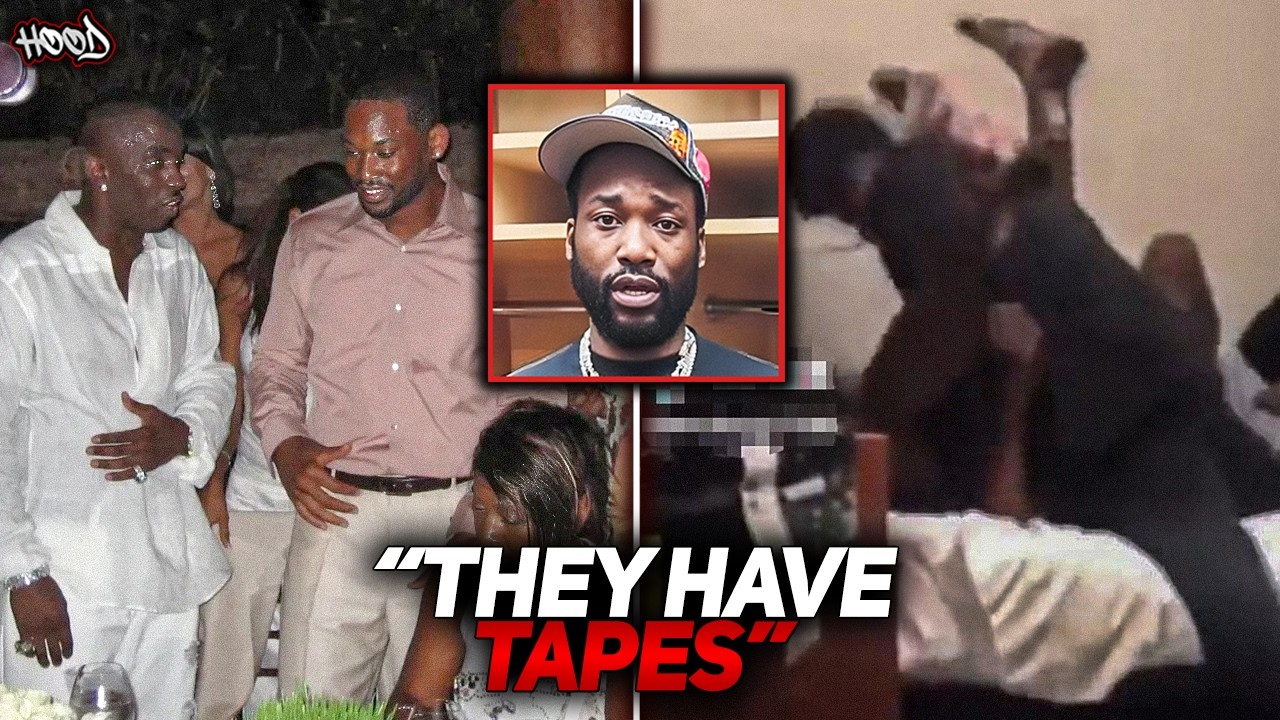
It was supposed to be a birthday celebration — the kind that lives on social media long after the lights go out.
Familiar faces, camera flashes, laughter that sounded just a little too sharp around the edges.
For a while, everything looked exactly how it was meant to look.
And then, depending on who you ask, something shifted.
No official statement has laid out a timeline.
No clear footage tells a full story from beginning to end.
What exists instead are fragments — short clips, whispered accounts, posts that appeared and disappeared, and a wave of speculation that spread faster than anyone could contain it.
At the center of it all is Meek Mill, a figure no stranger to public scrutiny, controversy, and moments that seem to blur the line between spectacle and something far more personal.
Witnesses say the energy in the room changed first.
Not dramatically.
Not in a way that would make someone run for the exits.
More like a ripple — a subtle break in rhythm.
The DJ, mid-set, glanced away from the booth.
A small cluster formed where there hadn’t been one seconds before.
A few phones lowered instead of rising.
In party environments built on performance, those tiny details stand out.
Some claim Meek looked distracted earlier in the night.
Others insist he was in good spirits, moving through the crowd, greeting people, playing the host.
That contradiction is part of what’s fueling the mystery.
The version of him in early videos doesn’t match the version described later — the one who, according to several attendees, left abruptly, without the kind of exit a headliner usually makes at his own event.
Then came the detail that turned a confusing moment into a viral talking point: people began saying there was blood.
No verified source has confirmed how, why, or even if that’s accurate.
But the word alone was enough.
In a culture where rumors travel faster than facts, “blood” carries weight.
It transforms a simple departure into something cinematic, alarming, open to interpretation.
A stain on the floor, someone’s hand pressed to fabric, a security guard moving quickly — any of those, real or misread, can become the seed of a story that grows beyond recognition.
Videos circulating online show movement, tension, people looking toward something just out of frame.
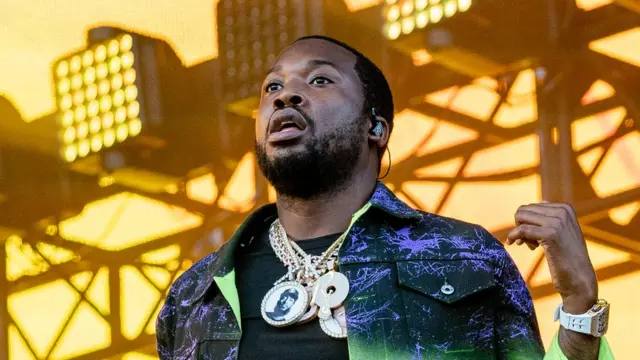
None show a clear incident.
None provide context.
Yet they’ve been replayed thousands of times, slowed down, zoomed in, analyzed like footage from a crime thriller rather than a party that may have simply gotten chaotic.
That’s where the narrative splits.
One side argues it was nothing more than a minor injury, the kind that happens in crowded spaces — a bumped glass, a cut, an accident magnified by celebrity presence.
In that version, Meek leaving quickly wasn’t dramatic; it was practical.
Handle the issue, avoid escalation, keep things from spiraling in a room full of cameras.
The other side leans into darker possibilities.
They point to the suddenness, the lack of immediate clarification, the history of tension that often follows high-profile figures.
They ask why the music reportedly stopped so abruptly.
Why certain guests seemed eager to leave.
Why no one from the inner circle rushed online to dismiss concerns right away.
Silence, in moments like this, becomes its own kind of statement — even if it isn’t meant to be.
Those close to the scene describe security moving with unusual urgency.
Not panic, exactly, but focus.
A clearing of space.
Short, quiet exchanges.
The kind of choreography that suggests something required attention, but not necessarily public alarm.
It’s the gray area that keeps people guessing: serious enough to disrupt the night, controlled enough that there was no visible chaos spilling into the street.
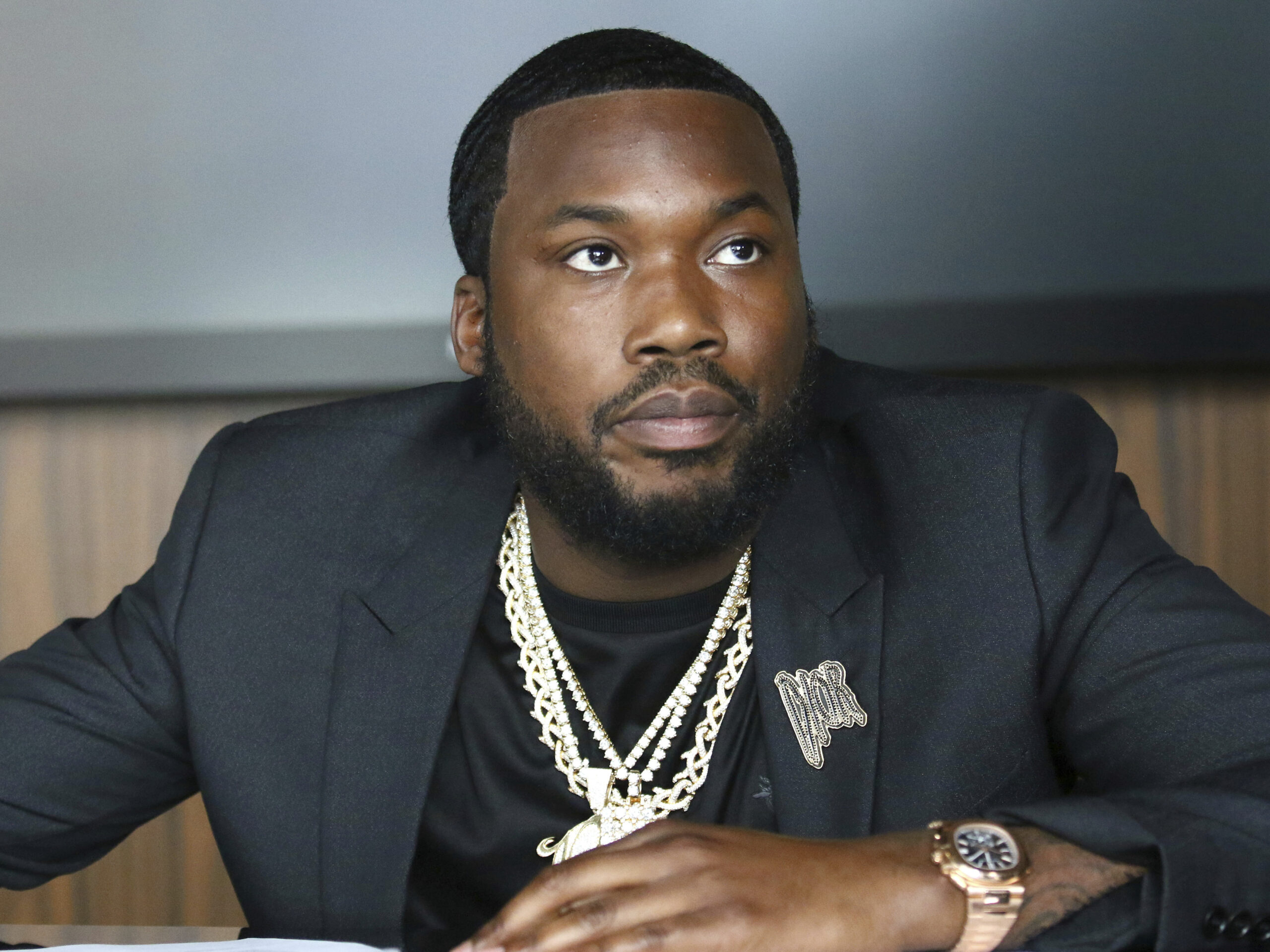
Meek Mill’s career has often unfolded under a microscope.
Legal battles, industry tensions, public feuds — he’s someone whose life story has never stayed private for long.
That history colors how moments like this are interpreted.
If the same scene happened at an unknown person’s party, it might pass as an unfortunate footnote.
With him, it becomes a headline, a thread, a theory waiting to be built.
There’s also the performance factor.
Modern celebrity events exist in two layers: the real one and the one designed for the feed.
When something disrupts that carefully curated surface, the contrast is jarring.
Guests who were filming dance clips minutes earlier suddenly have nothing to post — or choose not to.
That absence creates a vacuum, and vacuums get filled.
Some attendees, speaking indirectly through friends or vague posts, describe feeling “uneasy” without being able to explain why.
Others downplay it entirely, suggesting the internet has once again inflated a moment beyond proportion.
Both things can be true at once: an incident that was real to those present, and a narrative that has since grown larger than the event itself.
What’s undeniable is that Meek left.
For an artist known for commanding rooms, that image — him stepping away from his own celebration, whether hurried or simply purposeful — lingers.
It’s not dramatic on its own.
People leave parties all the time.
But placed inside an atmosphere already charged with uncertainty, it takes on symbolic weight.
Exit becomes escape.
Quiet becomes secrecy.
A practical decision becomes a cliffhanger.
Industry insiders note how quickly stories like this become part of a larger mythology.
A single night, half-seen and half-imagined, can attach itself to a public figure’s narrative for years.

It becomes referenced in interviews, alluded to in lyrics, used as evidence by fans and critics alike, regardless of what actually happened.
The most striking element may be how little concrete information exists compared to how much conversation there is.
In the hours after the party, timelines overlapped, contradicted, blurred.
Screenshots replaced statements.
Reactions outpaced reports.
By the time more grounded voices tried to slow the story down, the more dramatic versions had already taken root.
Somewhere in the middle of the noise is a simpler possibility: a private matter that unfolded in a very public space, handled quickly, and then swallowed by speculation.
But simplicity rarely satisfies an audience trained to look for hidden layers.
For now, what remains is atmosphere — the memory of music cutting short, of glances exchanged, of a host no longer in the room.
Whether the truth is mundane or complicated, the moment has already shifted from event to legend, shaped as much by imagination as by fact.
And maybe that’s the part that says the most.
In a world where every celebration is a stage and every stage has an audience, even an unclear ending can feel like the start of a much bigger story.