
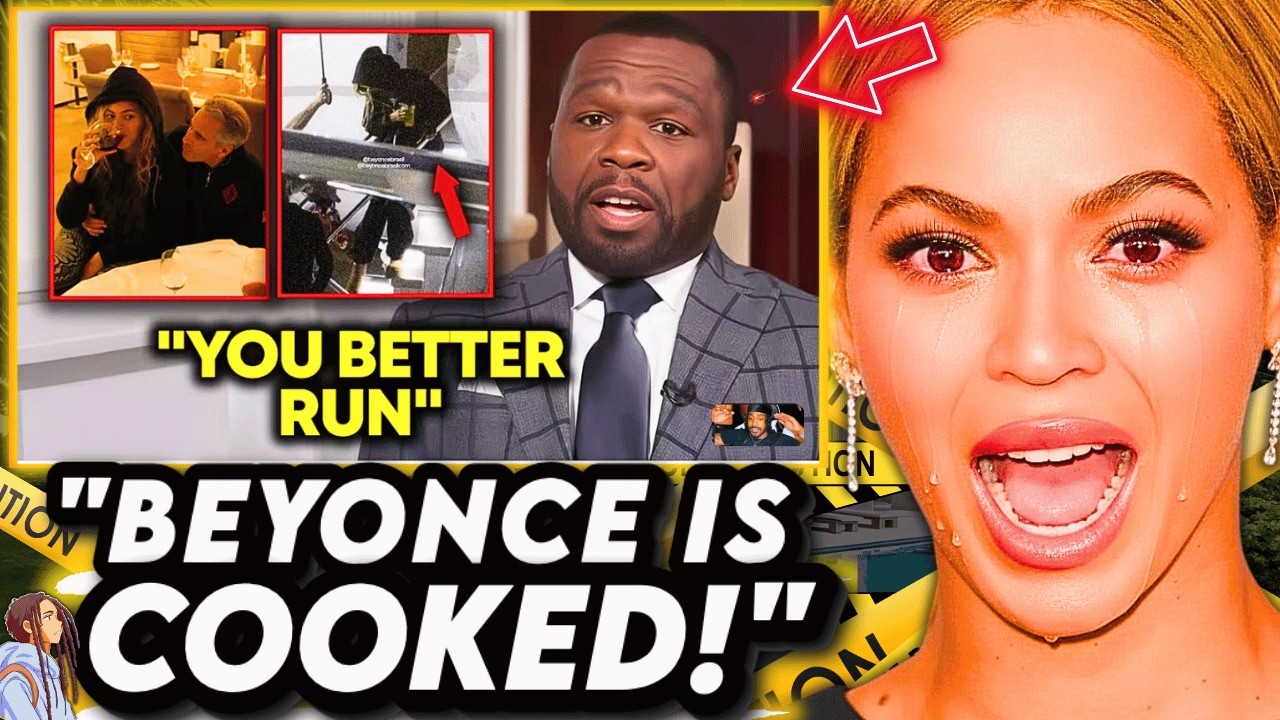
50 CENT SENDS A CHILLING WARNING: “LEAVE BEFORE IT’S TOO LATE” — BEYONCÉ’S NAME SUDDENLY SURFACES IN THE EPSTEIN FILES
The internet does not erupt quietly anymore.
It trembles first, then shakes, and then it explodes.
This time, the tremor began with a resurfaced wave of documents tied to Jeffrey Epstein.
Old files, sealed testimonies, fragments of names that had already haunted headlines once before.
For years, the world believed that chapter had closed with more questions than answers.
But history has a way of reopening doors people assumed were permanently locked.
As discussions reignited across digital platforms, speculation moved faster than facts.
Names were whispered, timelines were dissected, and screenshots began circulating like wildfire.
And then 50 Cent entered the conversation.
He did not deliver a press conference.
He did not publish a detailed accusation.
Instead, he posted words that felt pointed yet incomplete.
A warning without context.
A message that sounded less like commentary and more like caution.
“Leave before it’s too late,” he implied, in a tone that carried weight far beyond humor.
The statement alone might have faded into the endless churn of social media.
But it did not fade.
Because alongside that warning, Beyoncé’s name suddenly surfaced in online discussions.
No formal charges.
No documented accusations.
No verified evidence connecting her to criminal activity.
Yet the timing alone was enough to ignite controversy.
Why now, observers asked.
Why speak in riddles when the public is already on edge.
Was it satire, strategy, or something else entirely.
Those who follow 50 Cent know his history of calculated provocation.
He has built a brand on blunt commentary and fearless online sparring.
He understands exactly how to trigger a reaction without crossing certain lines.
And this reaction was immediate.
Fans defended.
Critics speculated.
Influencers amplified.
Headlines multiplied within hours.
Beyoncé, one of the most influential artists of her generation, has rarely been associated with scandal.
Her public image has long been defined by discipline, privacy, and precision.
She chooses her appearances carefully.
She releases statements rarely.
She avoids impulsive online battles.
Which makes silence, in moments like this, feel louder than noise.
The Epstein files themselves remain a complicated web of associations, travel logs, testimonies, and legal arguments.
Being named in such documents does not automatically imply wrongdoing.
Legal experts have repeatedly emphasized that inclusion in a file can mean many things.
Yet the court of public opinion rarely waits for nuance.
Online culture thrives on implication.
Ambiguity becomes fuel.
And when a celebrity of Beyoncé’s magnitude is even loosely mentioned in trending conversations, the effect multiplies instantly.
Some argue that 50 Cent’s words were nothing more than strategic engagement.
Others insist that the tone suggested inside knowledge.

But there is, as of now, no verified evidence supporting any criminal claims against her.
That distinction matters.
Still, the atmosphere remains charged.
It feels like standing in a room where someone has whispered a secret but refused to finish the sentence.
People lean closer.
They replay the clip.
They reread the caption.
They search for hidden meanings between syllables.
The psychology of scandal operates on suggestion rather than proof.
A single phrase can reshape an entire narrative.
And in the era of viral amplification, context often arrives too late.
What makes this moment particularly volatile is the legacy of the Epstein case itself.
It represents unanswered power dynamics.
It symbolizes elite networks and shadowed connections.
It leaves behind unresolved discomfort.
So when any prominent figure is mentioned alongside that legacy, tension spikes automatically.
Some analysts believe 50 Cent understands this dynamic perfectly.
He knows the temperature of the room.
He knows when a topic is combustible.
His message, whether serious or satirical, landed precisely where it would echo the loudest.
Meanwhile, Beyoncé’s camp has not issued a direct response to the online swirl.
Silence can signal confidence.
It can also signal strategy.
Or it can simply reflect the decision not to validate speculation.
The absence of clarification leaves space for imagination.
And imagination, once activated, rarely shrinks back on its own.
Digital detectives have begun mapping timelines.
They compare flight logs.
They analyze event photos.
They stitch together fragments that may or may not hold relevance.
Yet none of it, so far, constitutes proof of misconduct.
It is a reminder of how quickly association can morph into assumption.
The larger question may not be about guilt at all.
It may be about narrative control.
Who shapes the storyline first.
Who frames the interpretation before facts settle.
In controversies like this, perception often precedes reality.
Reputations are tested not only by evidence but by timing.
The entertainment industry has witnessed similar storms before.
Careers have survived them.
Others have not.
The difference often lies in documentation, transparency, and public trust.
Beyoncé’s decades-long career has cultivated significant loyalty.
That loyalty now functions as both shield and spotlight.
Supporters demand clarity from accusers.
Critics demand explanation from silence.
And in the center of it all stands a single unresolved post from 50 Cent.
Was it a genuine warning.
Was it dark humor misinterpreted.
Was it commentary on media hysteria itself.

Without explicit clarification, interpretation becomes projection.
It is important to emphasize that no verified legal document currently accuses Beyoncé of criminal conduct related to Epstein.
Speculation does not equal evidence.
Association does not equal guilt.
Yet public discourse rarely moves at the pace of legal process.
It moves at the speed of intrigue.
What happens next depends largely on whether new, substantiated information emerges.
If nothing concrete appears, this moment may dissolve into the archive of viral controversies.
If credible revelations surface, the narrative could shift dramatically.
For now, the tension lives in uncertainty.
A warning was issued.
A name was mentioned.
A file was reopened in the public imagination.
And millions are watching closely.
In a culture addicted to exposure, even a whisper can feel like thunder.
Whether this storm builds or breaks apart will depend not on implication, but on evidence.
Until then, the story remains suspended between caution and conjecture, echoing louder with every refresh of the screen.