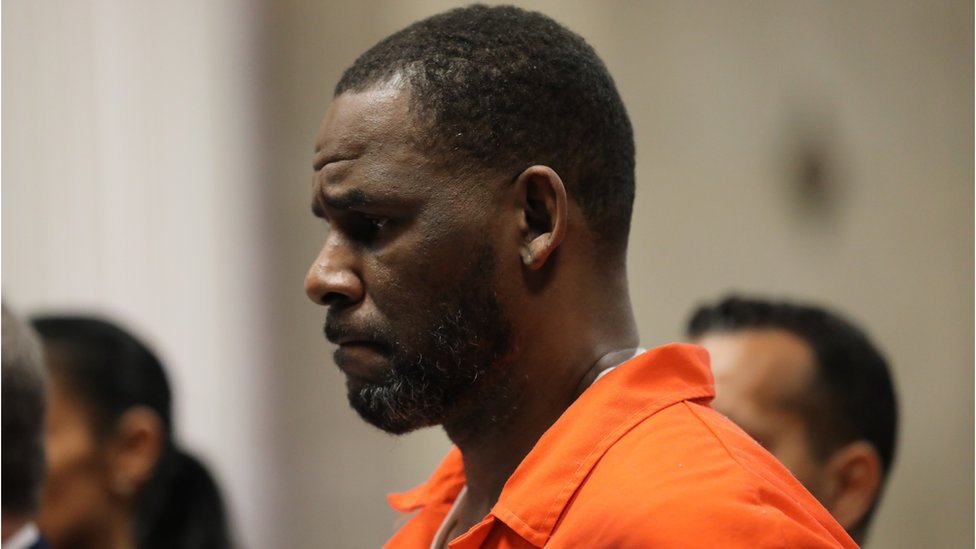
The federal sentencing of R Kelly has entered a new chapter as updated correctional records confirm a projected release date of December 21, 2045.
The date, now widely circulated across media platforms, underscores the long legal road that remains for the once dominant R and B figure whose career shaped a generation of contemporary music.
Kelly is currently serving a 30 year federal sentence stemming from a racketeering conviction in New York, along with an additional 228 month sentence handed down in Chicago.
The Chicago term is set to run largely concurrent with the New York sentence, with 12 months scheduled to be served consecutively.
In practical terms, that means the bulk of the penalties overlap, but the overall incarceration period still extends decades into the future.
The Chicago sentencing, delivered at the Dirksen Federal Building, followed convictions on three counts related to the production of child exploitation material and three counts tied to coercion of minors.
The courtroom proceedings were described by observers as deeply emotional.

Several accusers presented victim impact statements detailing years of alleged abuse, characterizing the singer as controlling and manipulative.
Their testimonies marked a decisive moment in a case that had lingered in public discourse for decades.
Kelly has been incarcerated since 2019, though he has spent the last phase of his confinement at a medium security federal facility in Butner, North Carolina.
Reports indicate he was transferred there in April 2023.
According to federal inmate records cited by CBS News and amplified by music outlets such as RAP TV, his projected release date now reflects the combined weight of his sentences.
At 59 years old, a 2045 release would place him well into his late seventies upon potential freedom.
Legal experts note that while federal sentences can sometimes be adjusted for good behavior or other qualifying programs, significant reductions are rare in cases involving serious federal convictions.
Multiple motions filed by Kelly legal team have already been denied, including efforts seeking a new trial, home confinement, and the removal of prosecuting authorities from his case.
In August 2025, a motion aimed at disqualifying the United States Attorney Office involved in his prosecution was rejected by Judge Martha McCool.
The court described the request as extreme and lacking exceptional justification.
With that ruling, many analysts believe Kelly remaining legal avenues have narrowed considerably.
Despite his circumstances, Kelly creative output has not entirely ceased.
Over the past year, audio clips have surfaced online featuring the singer recording vocals over existing instrumentals during phone calls from prison.
One such clip, layered over a track associated with Chris Brown, circulated widely on social media.
The snippet drew attention not only for the voice that once dominated airwaves, but also for the industry figures who acknowledged it publicly.
Producer Teddy Riley shared a birthday message referencing unreleased music and described Kelly as still the king of R and B.
That endorsement reignited debate about the separation of art and artist.
Supporters argue that musical genius can be acknowledged independently of personal conduct.
Critics maintain that the severity of Kelly convictions makes celebration inappropriate.
The cultural divide remains sharp.
Kelly catalog includes landmark albums such as 12 Play and R, along with songwriting and production credits that helped define the sound of 1990s and early 2000s R and B.
Songs like I Believe I Can Fly and Ignition Remix became global anthems.
For many listeners, his music formed the soundtrack to formative life moments.
Yet the legal findings against him have reshaped his public legacy.
In 2021, a New York jury found him guilty of racketeering and s*x trafficking related offenses.
In 2022, a Chicago jury returned additional guilty verdicts tied to child exploitation charges.
Together, those decisions effectively ended one of the most influential careers in modern black music.
Observers note that the downfall was gradual rather than sudden.
Allegations surrounding Kelly date back to the 1990s, including controversy over his relationship with the late singer Aaliyah when she was a teenager.
The song Age Ain’t Nothing but a Number, written and produced by Kelly, later took on unsettling overtones in light of subsequent accusations.
For years, rumors and civil lawsuits circulated, but criminal accountability proved elusive until federal prosecutors assembled expansive cases in New York and Illinois.
The renewed attention to his projected release date has prompted broader conversations about punishment, accountability, and redemption.
Some commentators argue that the 30 year sentence, combined with the concurrent 228 month term, reflects the seriousness of the crimes as determined by juries.
Others contend that the punishment effectively amounts to a life sentence for a man already approaching his sixties.
Within correctional facilities, inmates often focus intensely on projected release dates.
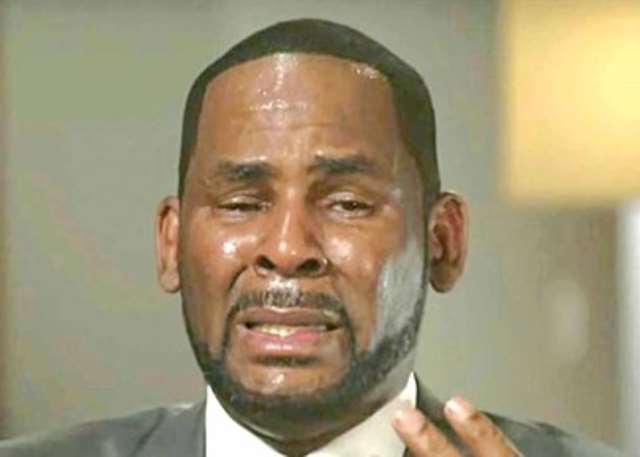
Formerly incarcerated individuals frequently describe the psychological toll of serving long sentences without clarity about an end point.
A confirmed date, even decades away, can provide structure, though it also underscores the magnitude of time remaining.
Kelly legal team has signaled that appeals will continue.
However, federal appeals courts historically overturn convictions only when clear procedural errors or constitutional violations are demonstrated.
Thus far, courts reviewing Kelly case have found the trials met required legal standards.
Beyond the courtroom, the music industry response has been complex.
Some artists who previously collaborated with Kelly have distanced themselves, removing joint tracks from streaming platforms or issuing statements of disapproval.
Others have remained silent.
The hesitation reflects a tension between professional association and public perception in an era shaped by social accountability movements.
Streaming data shows that while Kelly numbers dipped sharply following the convictions, his music has not disappeared.
Catalog streams continue, though at lower levels than during his commercial peak.
The persistence of his songs highlights the complicated relationship audiences maintain with controversial figures.
Cultural historians draw parallels to earlier moments when celebrated artists faced serious allegations.
The debate often centers on whether creative contributions can be preserved independently of personal wrongdoing.
In Kelly case, that question is intensified by the nature of the convictions and the detailed testimony presented during trial.
The Chicago sentencing hearing provided a forum for survivors to speak publicly about trauma they said lasted years.
Legal analysts describe victim impact statements as powerful elements of federal proceedings, offering judges insight into harm caused beyond statutory language.
For those who testified, the hearing represented a measure of validation after prolonged silence.
As December 21, 2045 stands as the projected release date, the path forward appears largely fixed.
While good conduct credits and potential policy changes could theoretically adjust timelines, no immediate mechanisms suggest a dramatic shift.
The Bureau of Prisons calculates release projections based on statutory formulas, and those figures typically remain stable barring extraordinary developments.
Kelly case also reflects broader changes in how the justice system addresses high profile figures.
Federal prosecutors increasingly rely on racketeering statutes to aggregate patterns of behavior over extended periods.
In Kelly New York trial, that strategy proved decisive, allowing jurors to consider a broad narrative rather than isolated incidents.
For supporters who continue to emphasize his musical talent, the 2045 date symbolizes loss as much as accountability.
They point to his ability to craft melodies, arrange harmonies, and produce chart topping hits as evidence of singular artistry.
Critics counter that talent does not shield anyone from consequences.
The tension between admiration and condemnation defines the current stage of his story.
He remains behind prison walls, reportedly continuing to write and compose in limited ways.
Yet the possibility of a public comeback appears remote given the length of his sentence and the damage to his reputation.
In the end, the confirmed release projection offers clarity where speculation once dominated.
For years, observers questioned how long Kelly would remain incarcerated.
Now, barring significant legal reversal, the timeline extends nearly two decades ahead.
The arc of his career spans meteoric rise, sustained dominance, mounting allegations, and eventual conviction.
The projected 2045 release date cements that arc in stark terms.
It marks not only a legal milestone but also a cultural turning point, closing one era of R and B history while leaving unresolved debates about art, accountability, and the possibility of redemption.
For now, the numbers speak plainly.
A 30 year federal sentence, a concurrent 228 month term, and a projected freedom date set for late 2045 define the reality facing R Kelly.
Whatever conversations continue in studios, social feeds, or living rooms, his immediate future remains confined to the boundaries of a federal institution, far removed from the stages that once defined his name.