
🚨 LEAKED “TOP-SECRET MEDICAL FILE” ON DIDDY IN PRISON? Warden Allegedly Reveals Sensitive Health Condition That Shocked the Entire Cellblock
The rumor did not begin with a press conference.
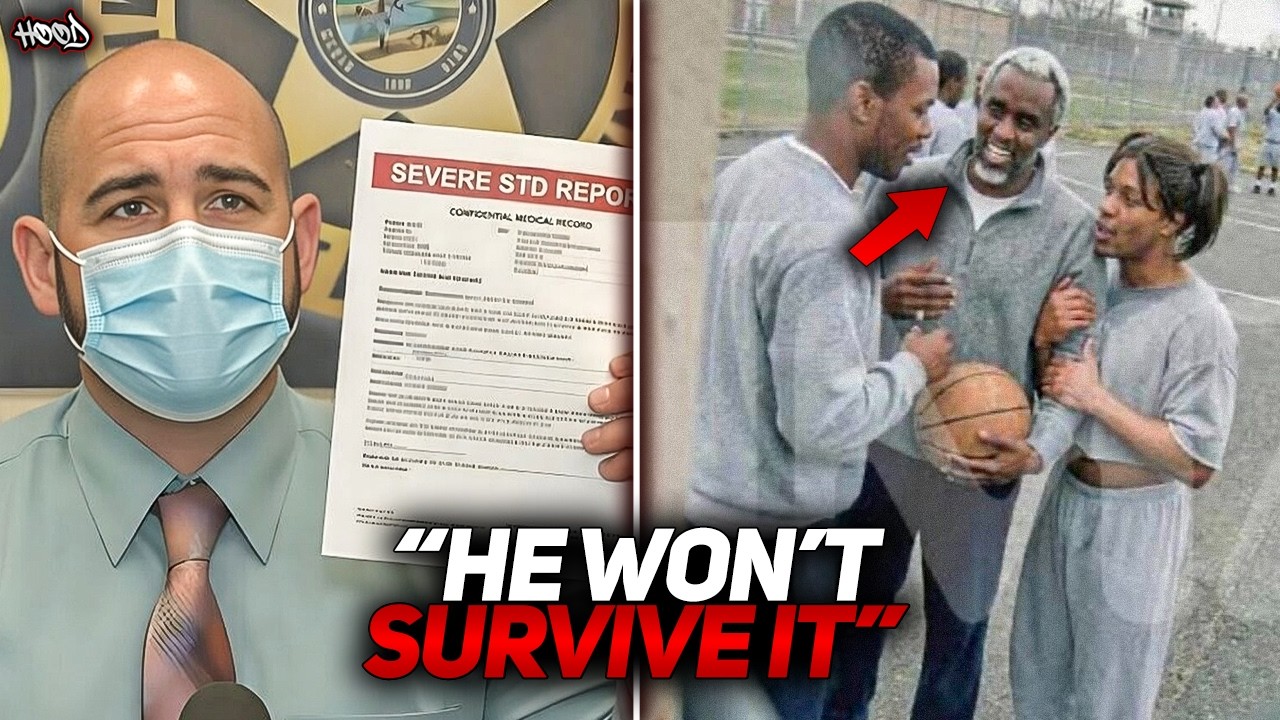
There were no flashing cameras, no official statements stamped with institutional seals.
It began, as so many explosive stories do, with a whisper—one that allegedly slipped beyond reinforced doors and razor wire, carried by someone who claimed to have seen something not meant for public eyes.
Inside a federal detention facility where silence is currency and information is tightly rationed, talk of a “medical file” connected to Sean “Diddy” Combs began circulating among inmates and staff alike.
According to individuals who describe themselves as familiar with internal operations, a report concerning the music mogul’s health status was discussed behind closed doors.
The contents of that alleged report remain unverified.
No documents have surfaced publicly.
No authority has confirmed its existence.
Yet the suggestion alone has ignited a storm of speculation that refuses to subside.
What exactly was in that file? That depends on who is telling the story.
One version claims the document referenced a serious health concern—something communicable, something sensitive, something that would inevitably trigger heightened protocols within any correctional institution.
Another version insists the report was routine, exaggerated by gossip and magnified by the notoriety of the inmate involved.
Between those two extremes lies a vacuum filled with conjecture.
Correctional facilities operate under strict medical privacy rules.
Inmates, regardless of fame, are entitled to confidentiality.
Any breach—intentional or accidental—would constitute a serious violation.
That reality makes the alleged “leak” all the more puzzling.
If a staff member truly disclosed protected medical information, the consequences could be severe.
And yet, no disciplinary action has been publicly acknowledged.
No investigation has been formally announced.
That silence has become fuel.
Observers point to the timing.
Diddy, once celebrated as a titan of the entertainment industry, now finds himself navigating a vastly different landscape.
Legal battles, civil suits, and intense public scrutiny have altered the narrative surrounding his name.
In such an environment, even the faintest suggestion of a health scandal can spread with astonishing velocity.
Social media, ever hungry for controversy, amplified fragments of hearsay into viral threads within hours.
Still, separating fact from fiction remains nearly impossible.
Individuals claiming proximity to the situation describe hushed conversations among correctional officers.
They speak of tightened procedures, of medical staff entering secured areas with increased frequency.
Yet none have provided tangible proof.
No images.
No authenticated paperwork.
Only descriptions colored by implication.
It is important to underscore that there is no verified confirmation that Diddy is suffering from any specific illness.
Public records do not substantiate the more sensational claims circulating online.
Representatives have not issued statements addressing the rumors directly, which some interpret as strategic restraint and others as evasive silence.
In the absence of clarity, speculation thrives.
The psychology behind such rumors is not new.
High-profile figures have long been subjected to invasive curiosity about their private lives, particularly when their public image contrasts sharply with their current circumstances.
The idea of a powerful mogul facing vulnerability—physical or otherwise—carries a certain dramatic weight.
It humanizes, destabilizes, and sometimes vilifies, depending on perspective.
Within correctional environments, health-related issues are managed under strict guidelines.
Screening upon intake is standard procedure.
Testing for communicable conditions is routine.
Treatment protocols are codified.
If there were indeed a legitimate medical matter of concern, it would likely be addressed internally without fanfare.
The notion that such information would leak casually raises legitimate questions about motive.
Why now? Why this detail?
Some analysts suggest that rumors of illness often emerge in high-profile incarcerations as a form of narrative warfare.
Health can become symbolic—representing decline, accountability, or vulnerability.
Others argue that the public fascination stems from deeper cultural impulses: the desire to see the mighty brought low, or the suspicion that privilege shields celebrities even within prison walls.
The alleged involvement of a “warden” adds another layer of intrigue.
Wardens occupy administrative roles; they are not typically privy to detailed medical charts beyond operational necessity.
If someone identifying as such did indeed reference a medical file, it could have been based on secondhand knowledge.
Or it could have been misinterpreted commentary inflated into scandal.
Meanwhile, advocacy groups warn against the reckless spread of unverified medical claims.
False allegations about communicable diseases can perpetuate stigma and cause real harm.
In the digital age, reputations can be reshaped by rumor alone, regardless of eventual clarification.
Once an idea lodges in the public consciousness, retracting it becomes nearly impossible.
And yet, the appetite for answers persists.
Online forums dissect every perceived clue.
A delayed court appearance becomes evidence.
A reported medical visit morphs into confirmation.
Even silence from official channels is interpreted as strategic containment.
Each new post builds upon the last, creating a self-sustaining ecosystem of speculation.
Legal experts note that medical privacy laws extend to incarcerated individuals.
Should concrete proof of a breach surface, civil remedies could follow.
But thus far, the conversation remains suspended in ambiguity.
No authenticated whistleblower has stepped forward publicly.
No investigative outlet has produced corroborated documentation.
What remains is atmosphere—charged, uncertain, and undeniably compelling.
Diddy’s trajectory from industry mogul to incarcerated defendant has already reshaped public perception.
The addition of a rumored health crisis injects a new dimension, one that blurs the line between accountability and voyeurism.
For some observers, the focus should remain on legal proceedings and due process.
For others, the personal dimension—however speculative—adds texture to a narrative they believe is far from complete.
In moments like this, the absence of verified information becomes its own headline.
The void invites projection.
It invites imagination.
It invites debate.
Until official confirmation or denial emerges, the alleged medical file exists primarily as a story about a story—a reflection of how quickly information can metastasize in the modern media ecosystem.

It reveals less about documented health conditions and more about public fascination with the private vulnerabilities of powerful figures.
Perhaps the most striking element is not what the rumored report supposedly contains, but how swiftly it transformed into viral discourse.
In an era where attention is currency, even unverified whispers can command global focus.
The prison walls that were meant to contain have instead become the backdrop for a drama unfolding in plain sight.
For now, the facts remain limited.
Diddy is incarcerated.
Legal challenges continue.
Medical privacy laws stand intact.
Everything else resides in the realm of allegation.
Whether the truth, once clarified, will validate or dismantle the rumor remains to be seen.
What is certain is that the story—born from a whisper—has grown into a thunderclap of speculation.
And until substantiated information replaces conjecture, the tension between secrecy and exposure will continue to captivate an audience eager to know what, if anything, lies inside that purported file.
Behind steel doors and beyond public view, reality and rumor coexist.
The difference between them may ultimately hinge not on whispers, but on evidence.