Kanye West Drops a Shockwave: Accuses the Kardashians of Shadowy Ties to Jeffrey Epstein — How Long Has the Truth Been Hidden?
In the unpredictable theater of celebrity culture, few figures understand the power of disruption quite like Kanye West.
Over the years, he has mastered the art of turning a single statement into a cultural tremor.
This time, however, the aftershock feels different.
It isn’t just about fashion, music, or personal grievances.
It’s about names that carry weight.
Names that open doors—and close them just as quickly.
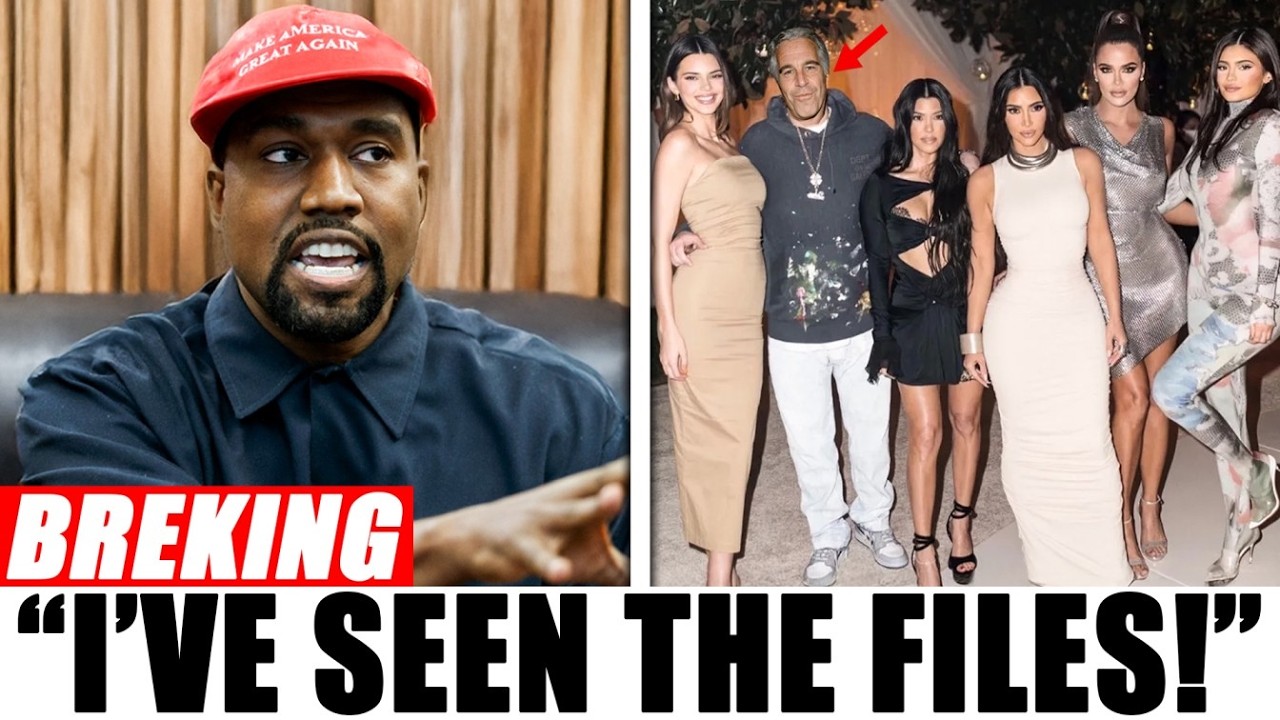
During a recent string of remarks that ricocheted across social media within minutes, West alluded to what he described as “connections people don’t want discussed.
” He referenced the family empire built in front of cameras and sustained behind them—the dynasty made globally recognizable through Keeping Up with the Kardashians.
Then, almost casually, he invoked another name.
A name that once detonated across headlines worldwide: Jeffrey Epstein.
The room—digital or otherwise—went silent.
To understand the magnitude of that pairing, one has to rewind.
Epstein’s network, once whispered about in elite circles, became the center of global scrutiny after criminal investigations exposed a web of powerful associations spanning politics, academia, business, and entertainment.
Court documents, flight logs, redacted testimonies—each release added fuel to a fire that still smolders years later.
The scandal left an enduring question hanging in the air: how far did those connections really reach?
Against that backdrop, West’s decision to draw even a suggestive line between one of America’s most media-savvy families and a figure synonymous with corruption and secrecy was bound to ignite controversy.
But what, precisely, did he claim?
That’s where the fog thickens.
West did not present documents.
He did not cite court filings.
Instead, he spoke in implications—references to “circles,” to “shared rooms,” to “things that happened when cameras weren’t rolling.” His phrasing was pointed yet elusive, designed to provoke without fully anchoring itself to verifiable detail.
It was enough to spark a digital wildfire.
Within hours, hashtags surged.
Comment sections fractured into camps.
Some demanded proof.
Others insisted the silence itself was telling.
Hollywood, notably, did not respond with its usual speed.
Publicists who typically move at lightning pace seemed measured.
Carefully worded statements from affiliated representatives avoided direct engagement with the insinuations.
No lawsuits were immediately announced.
No fiery denials dominated prime-time talk shows.
Just an atmosphere of cautious distance, as though everyone was calculating risk.
Critics argue that West’s history of provocative statements diminishes the weight of his words.
They point to past controversies, to moments when bold claims dissolved into ambiguity.
Yet even detractors admit something uncomfortable: the mere association of names like these shifts public perception.
Once spoken aloud, they linger.
:max_bytes(150000):strip_icc():focal(749x0:751x2)/kardashian-west-1-7c112cb9303941a089a7b2595af84daa.jpg)
Supporters of the Kardashian brand have been quick to dismiss the remarks as another episode in a long-running personal saga.
After all, West’s prior relationship with the family—particularly through his marriage to Kim Kardashian—was highly public, intensely scrutinized, and ultimately turbulent.
Some see the comments as an extension of unresolved grievances, a continuation of a personal war reframed as public revelation.
But others are asking a different question: why now?
Timing, in the world of influence, is rarely accidental.
Recent years have seen renewed public appetite for accountability among the powerful.
Documentaries dissecting elite networks trend across streaming platforms.
Social media investigators comb through archival images, scrutinizing background details once overlooked.
In this climate, even an unproven hint can catalyze an avalanche of speculation.
Archival photos have already resurfaced—images of gala events, charity functions, private gatherings attended by an array of high-profile figures over decades.
To be clear, appearing at the same event as someone later accused of crimes does not imply wrongdoing.
The social ecosystems of wealth and fame are notoriously interconnected.
Yet the internet thrives on pattern recognition.
And patterns, once imagined, can be difficult to unsee.
Legal experts note that making direct allegations without substantiation carries substantial risk.
That West stopped short of explicit accusation may not be coincidence.
By framing his remarks as questions, as rhetorical nudges rather than declarative statements, he remains within a gray zone—provocative enough to stir curiosity, cautious enough to avoid immediate legal confrontation.
Meanwhile, the broader public conversation reveals a deeper tension.
Trust in institutions—media, government, celebrity culture—has eroded in recent years.
Epstein’s case amplified that skepticism.
Many believe that the full scope of his network was never fully disclosed.
Others argue that conspiracy theories have eclipsed verified facts, muddying the waters beyond recognition.
In that charged environment, West’s words function less as evidence and more as ignition.
Observers of celebrity strategy suggest that controversy, for better or worse, sustains relevance.
In a media cycle that devours yesterday’s scandal by tomorrow afternoon, bold insinuations can dominate headlines long enough to redirect attention from other narratives.
Yet there is a counterargument: invoking a scandal of this magnitude risks backlash that even a seasoned provocateur might not fully control.
For the Kardashian empire, built meticulously over nearly two decades, image management has always been paramount.
From curated storylines to carefully timed business launches, the brand thrives on narrative control.
An external voice challenging that control—especially one with insider proximity—poses a unique challenge.
Still, proximity does not equate to proof.
No official documents currently substantiate a direct link between members of the Kardashian family and criminal proceedings involving Epstein.
Investigations into Epstein’s activities have named numerous individuals across industries, but public records must be distinguished from rumor.
It is precisely this distinction that becomes blurred in viral discourse.
And yet, silence speaks in its own language.
When powerful names collide in a single sentence, the cultural impact transcends factual verification.
It taps into collective suspicion.
It feeds a broader storyline about hidden networks and unspoken alliances.
Whether grounded in reality or amplified by imagination, the effect is the same: doubt spreads.
Some insiders speculate that this episode could fade as quickly as it erupted, replaced by the next headline-grabbing revelation.
Others believe it may linger, resurfacing periodically whenever related documents or investigations reenter the news cycle.
In the age of digital permanence, statements never truly disappear.
They wait.
West himself remains enigmatic.
Is he positioning himself as a whistleblower, a disruptor exposing unseen ties? Or is he leveraging shock value to maintain cultural dominance? The answer may depend less on his intent and more on what unfolds next.
If new evidence emerges—through investigative journalism, court disclosures, or insider testimony—the narrative could transform from speculative to seismic.
If not, it may settle into the long archive of celebrity controversies that flare brightly before dimming into footnotes.
For now, the tension persists.
Public fascination with the intersection of fame and secrecy shows no sign of waning.
The Epstein case left an indelible mark on collective consciousness, a reminder that power can conceal as much as it reveals.
When someone as polarizing as Kanye West suggests that familiar faces may intersect with that shadowed world, curiosity becomes almost inevitable.
In Hollywood, perception can be as potent as fact.
Brands rise and fall on whispers as much as on headlines.
And in the space between allegation and evidence lies a terrain where speculation thrives.
Whether this moment represents a genuine unraveling or merely another chapter in an ongoing saga of celebrity conflict remains to be seen.
But one truth is undeniable: when the curtain trembles, audiences lean forward.
And right now, many are watching—waiting to see if what was hinted at will ever step fully into the light.