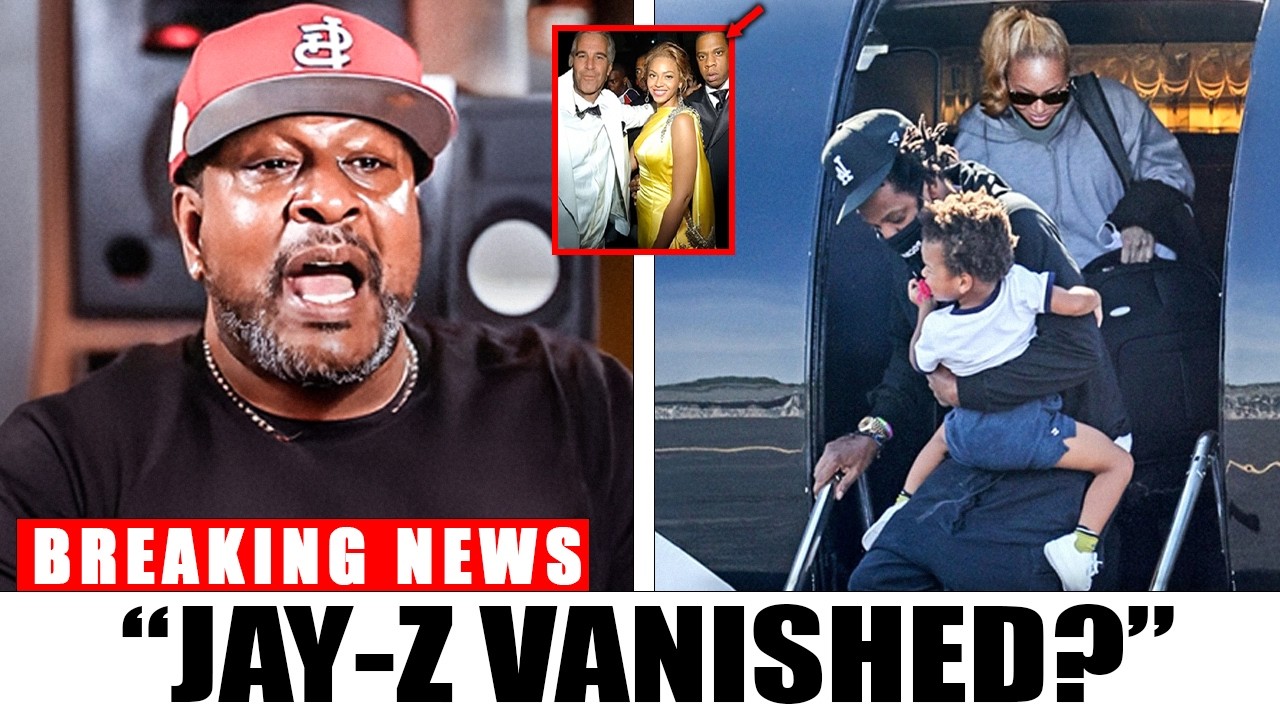
BREAKING LIVE: Jay-Z “Vanishes” After the Epstein Files — Gene Deal Speaks in Half-Truths, Hesitates Mid-Sentence, and the Terrifying Silence Behind Power
The moment the Epstein documents began circulating publicly, the atmosphere around certain powerful figures changed almost overnight.
It wasn’t loud at first.
There were no dramatic statements, no urgent press conferences, no frantic denials flooding social media.
Instead, there was something far more unsettling: silence.
And among the silences that stood out the most was that of Jay-Z.
For an artist and businessman whose presence has long been synonymous with visibility, influence, and control of narrative, the sudden absence was hard to ignore.
Jay-Z did not address the revelations.
He did not issue a clarification, a dismissal, or even a carefully worded statement.
He simply stopped appearing.
No interviews.
No public events.
No spontaneous sightings that tabloids could latch onto.
It was as if someone had quietly dimmed the lights around one of the most illuminated figures in modern culture.
At first, some dismissed it as coincidence.
High-profile individuals step back from the spotlight all the time, especially when the media climate turns hostile.
But the timing was uncomfortable.
The Epstein files didn’t just expose names; they reignited old questions about proximity, access, and power.
Questions that don’t require guilt to be damaging—only association.
And in that moment, Jay-Z’s absence felt less like rest and more like retreat.
Then Gene Deal spoke.
Or rather, he almost did.
Gene Deal, a longtime figure with deep ties to the inner circles of hip-hop’s most powerful era, appeared ready to shed light on what was happening behind the scenes.
His name alone carried weight.
He had seen things.
He had been present when decisions were made in private rooms, far away from cameras and fans.
When he began addressing the topic, expectations rose quickly.
Many assumed he would either defend Jay-Z outright or dismiss the speculation as baseless.
What followed was far stranger.
Gene Deal’s words circled the truth without landing on it.
He spoke slowly.
Carefully.

Certain names were mentioned only in passing, while others were conspicuously avoided.
When Jay-Z came up, his tone shifted—not accusatory, but restrained.
Almost cautious.
Sentences trailed off.
Pauses stretched longer than necessary.
At times, it felt like the most important parts of his thoughts were happening in the silence between words.
He did not say Jay-Z was involved.
He did not say Jay-Z was innocent.
He said enough to suggest awareness, and then stopped short, as if crossing an invisible line would come at a cost.
Observers noticed the pattern immediately.
This was not confusion.
This was restraint.
And restraint, in moments like these, tends to provoke more suspicion than outright denial.
As Gene Deal continued, he hinted at dynamics that extend beyond individual actions.
He spoke about power structures, about unspoken rules, about how certain names are protected not by law, but by leverage.
He alluded to environments where proximity itself is dangerous—not because of what you do, but because of what you know.
Each vague comment seemed to widen the gap between what the public could prove and what insiders might understand.
Jay-Z’s disappearance began to look less accidental.
In the entertainment industry, silence is rarely empty.
It is often strategic.
Sometimes it is advised.
Sometimes it is enforced.
When someone with Jay-Z’s resources chooses not to speak, it raises the question of whether speaking is even an option.
Is silence a shield, or is it a signal? Is it self-preservation, or compliance with forces larger than any one individual?
What made the situation even more unsettling was the absence of denial from those closest to him.
No strong rebuttals emerged.
No proxies stepped forward to “set the record straight.” The machine that usually hums smoothly around a figure of his magnitude seemed to stall.
That vacuum allowed speculation to thrive—and speculation, once ignited, is difficult to contain.
Some argue that Jay-Z’s name appearing in conversations surrounding Epstein does not imply wrongdoing.
That proximity in elite circles does not equal participation.
That powerful people often occupy the same spaces without sharing the same sins.
These arguments are reasonable.
But they clash with one undeniable reality: powerful people usually rush to make that distinction clear.
Jay-Z did not.
Gene Deal’s ambiguity only added fuel to the fire.
When pressed, he neither escalated nor extinguished the conversation.
Instead, he framed his responses as if he were weighing consequences.
The effect was chilling.
It suggested that the story is not about one man’s actions, but about an ecosystem where truth is fragmented, controlled, and selectively released.
There is also the question of timing.
Jay-Z’s retreat coincided not only with the resurfacing of Epstein-related documents, but with a broader cultural reckoning around accountability.
In such moments, public figures often attempt to get ahead of the narrative.
They issue statements, hire crisis managers, reposition themselves.
Jay-Z chose invisibility.
That choice has consequences.
In the absence of facts, patterns become evidence.
And the pattern here is difficult to ignore: explosive revelations, followed by a high-profile disappearance, followed by an insider who speaks just enough to imply danger in speaking further.
It reads less like coincidence and more like choreography.
Critics warn against turning ambiguity into accusation.
They caution that silence should not be mistaken for guilt.
Yet history has taught the public to be wary of stories that stop mid-sentence.
Too many past scandals followed the same rhythm: initial shock, strategic silence, controlled leaks, and only years later, partial truths emerging when the risk had passed.

Whether Jay-Z is connected to Epstein in any meaningful way remains unproven.
But the optics—the silence, the timing, the evasive commentary—have created a narrative that refuses to fade.
And narratives, once formed, take on a life of their own.
Gene Deal’s role in this unfolding drama is particularly telling.
As someone with little to gain and much to lose, his hesitation speaks volumes.
People who have nothing to fear tend to speak freely.
People who measure every word usually do so for a reason.
The unsettling possibility is that the full story is not meant to be understood all at once.
That it exists in fragments, scattered across whispers, pauses, and absences.
That Jay-Z’s disappearance is not an endpoint, but a signal—an indication that something beneath the surface is shifting.
In the end, what lingers is not what has been said, but what hasn’t.
The unanswered questions.
The strategic silences.
The sense that certain truths remain untouchable, protected not by lack of evidence, but by the weight of power behind them.
Jay-Z may return to the spotlight.
Gene Deal may speak more openly in time.
Or the story may slowly dissolve into background noise, replaced by the next scandal demanding attention.
But for now, the quiet remains.
And in that quiet, many are left wondering whether silence is simply absence—or the loudest warning of all.