Katt Williams “Ignites” Controversy After Bluntly Calling Out Nicki Minaj Following Her Moment With Donald Trump
The moment itself lasted only seconds.
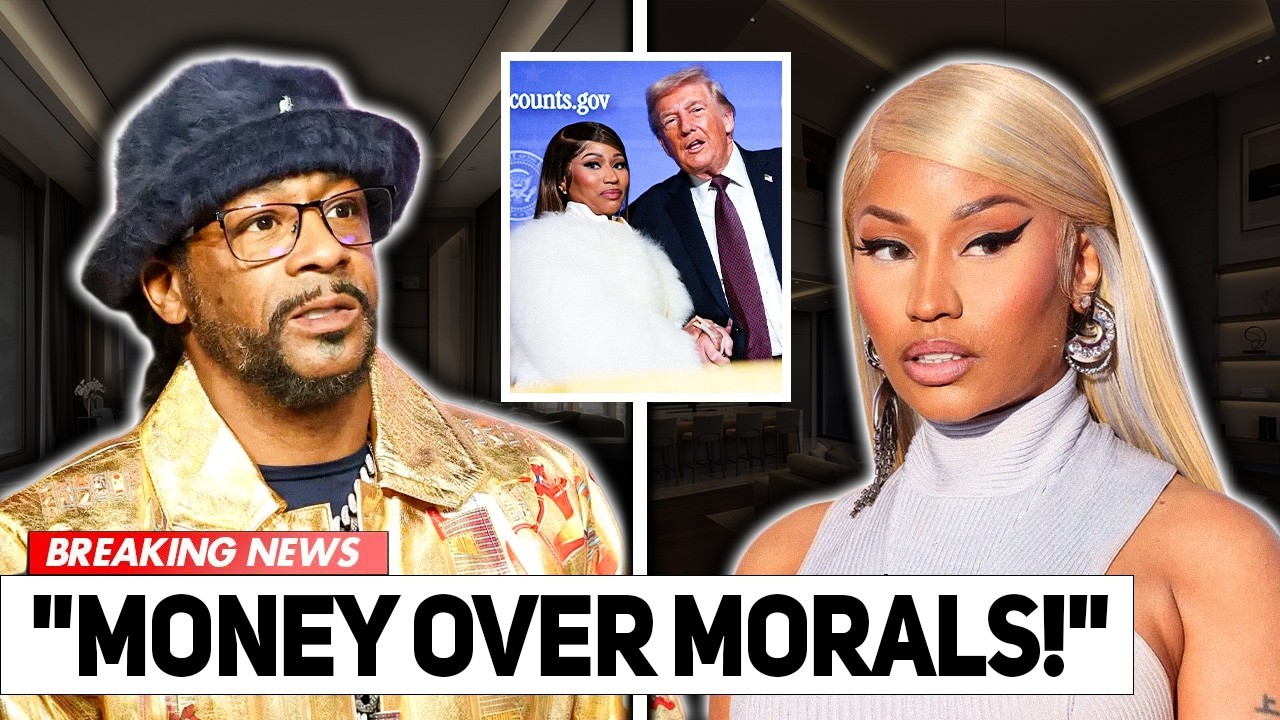
A brief walk.
A handshake.
A flash of cameras.
But in today’s climate, seconds are more than enough to ignite something far bigger.
When Nicki Minaj was seen alongside Donald Trump, the images traveled faster than context ever could.
Within minutes, timelines were split, comment sections were on fire, and speculation began stacking on top of speculation.
Was it a statement? A coincidence? A calculated move?
Before anyone could settle on an answer, another voice cut through the noise — sharp, unfiltered, and impossible to ignore.
On a stage lit for laughter, Katt Williams pivoted.
What began as comedy slowly transformed into something that felt heavier.
More pointed.
Less like a joke — more like a warning shot.
Audience members would later say they felt the shift in the room before they understood it.
The cadence changed.
The punchlines stretched thinner.
Then came the name.
Not whispered.
Not implied.
Said outright.
Nicki.
It wasn’t simply that he mentioned her.
It was how he did it.
The pauses were deliberate.
The tone sharpened.
He didn’t scream, but he didn’t need to.
The implication hung in the air longer than the applause that followed.
He questioned choices.
He questioned loyalty.
He questioned influence.
And without ever delivering a direct accusation, he constructed a narrative that left the crowd connecting dots on their own.
That’s what made it combustible.
Because nothing fuels controversy faster than suggestion.
Clips from the show began circulating almost immediately.
Some were cropped tightly to emphasize the harshest lines.
Others zoomed in on audience reactions — open mouths, nervous laughter, a few stunned expressions that seemed unsure whether to clap or stay silent.
Social media did what it does best: amplify, distort, dissect.

Supporters of Nicki Minaj called it opportunistic.
They argued that a comedian had seized a trending topic to extend his own relevance.
Critics, however, claimed he was saying what others were too afraid to articulate.
They framed it as accountability disguised as humor.
The truth, as always, appeared to live somewhere in the tension between those extremes.
The political backdrop made everything heavier.
Any public proximity to Donald Trump carries weight, whether intentional or not.
In an entertainment industry that often leans loudly in one direction, even perceived alignment in another can spark backlash.
And backlash, in 2026, rarely stays contained.
What remains unclear is what that brief appearance actually represented.
There has been no formal statement clarifying the context.
No press release explaining the purpose.
Just images.
And in the absence of explanation, interpretation takes over.
Katt Williams seemed to understand that vacuum — and stepped directly into it.
He never explicitly told the audience what to think.
He didn’t deliver a monologue condemning political ideology.
Instead, he posed questions wrapped in sarcasm.
He joked about influence, about power, about the responsibility of celebrities who command millions of followers.
He hinted that certain moves come with consequences — not just for the individual, but for the communities that helped build them.
The crowd’s reaction was fractured.
Some cheered loudly, almost relieved that someone had broken the silence.
Others shifted uncomfortably.
Comedy is often praised for pushing boundaries, but it becomes far more volatile when it intersects with politics and personal allegiance.
Behind the scenes, insiders suggest this wasn’t entirely spontaneous.
According to individuals familiar with the production, there had been murmurs backstage about whether he would address the controversy at all.
The decision, reportedly, was made close to showtime.
If that’s true, it adds another layer — not of chaos, but of calculation.
Because timing is everything.
The entertainment industry has long operated on unspoken codes.
Publicly challenging a peer, especially one as influential as Nicki Minaj, carries risk.
Yet Katt Williams has built his career on refusing to play by predictable rules.
That unpredictability is part of his brand.
It is also what makes moments like this so difficult to categorize.
Was he defending principles? Generating headlines? Sending a broader message about celebrity responsibility?
Or was this simply what happens when a performer feels compelled to speak, regardless of fallout?
Nicki Minaj, for her part, has not issued a direct response to the remarks made on stage.
Her social channels have remained active, but conspicuously silent on this particular issue.
Silence, of course, can be strategic.
It can also be temporary.
Observers note that she has weathered controversy before — and often emerged with her fanbase even more galvanized.
The loyalty of her supporters is not easily shaken.
In fact, moments of public criticism have historically strengthened that bond.
But this situation feels different to some.
Not necessarily because of politics alone, but because the criticism came from within the entertainment sphere itself.
It wasn’t a pundit.
It wasn’t a random social media user.
It was another high-profile figure, speaking live, in front of an audience, with cameras rolling.
That changes the dynamic.
Industry analysts point out that public disputes between major entertainers often serve multiple purposes.
They generate engagement.
They dominate news cycles.
They redirect attention.

Whether intentional or not, the clash has already succeeded in one measurable way: it has everyone talking.
And perhaps that’s the most revealing detail of all.
Because in the current media landscape, attention is currency.
Controversy is acceleration.
A viral moment can eclipse weeks of carefully planned promotion.
It can also redefine narratives overnight.
Some believe this entire episode will fade as quickly as it erupted, replaced by the next headline.
Others argue it signals a deeper fracture within celebrity culture — a growing expectation that public figures must declare allegiances, choose sides, and accept scrutiny for every association.
What cannot be denied is the intensity of the reaction.
The comments continue pouring in.
Think pieces multiply.
Fan accounts dissect body language, tone, even facial expressions captured in grainy footage.
Every frame becomes evidence in a debate that refuses to cool.
And still, the central question lingers.
Was that walk beside Donald Trump symbolic, strategic, or simply misunderstood?
Was Katt Williams acting as provocateur, commentator, or something in between?
Perhaps the real story isn’t about a single appearance or a single monologue.
Perhaps it’s about the fragile balance celebrities must maintain in an era where visibility is constant and interpretation is immediate.
One move can redefine perception.
One sentence can ignite division.
In the end, no official feud has been declared.
No formal statements have escalated the situation further.
Yet the tension remains — subtle, unresolved, hanging in digital air.
Because sometimes the loudest conflicts are not the ones confirmed.
They are the ones implied.
And in this case, implication has proven more than enough.