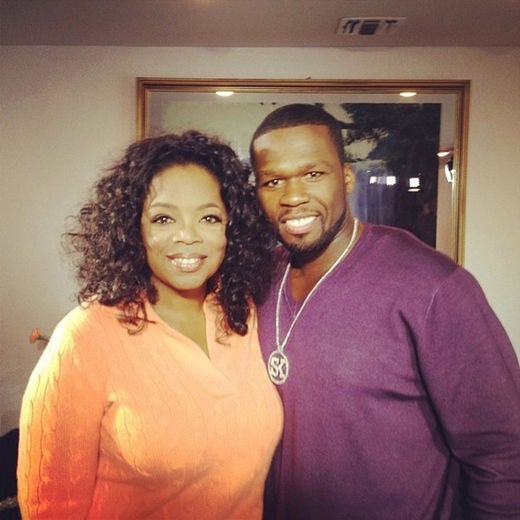
The entertainment world has been buzzing lately, and at the center of it all is a powerful clash involving some of Hollywood’s biggest names. Taraji P. Henson, the acclaimed actress known for her commanding presence in everything from Empire to Hidden Figures, recently poured her heart out about the harsh realities of pay disparity in the industry. Her words struck a chord, especially when she connected them to her experience with the highly anticipated musical adaptation of The Color Purple. And right on cue, rapper-turned-mogul 50 Cent jumped into the fray, offering his unwavering support to Taraji while reigniting his long-standing criticisms of Oprah Winfrey.
It all started during a heartfelt interview with Gayle King on SiriusXM, where Taraji, alongside director Blitz Bazawule and co-star Danielle Brooks, got emotional discussing her frustrations. When King asked about rumors that she was thinking of quitting acting, Taraji didn’t hold back. Tears welled up as she explained, “I’m just tired of working so hard, being gracious about what I do, getting paid a fraction of the cost.” She spoke of hearing the same complaints from her peers over and over, feeling the weight of a system that demands everything from Black actors while offering far less in return. Taraji even revealed she almost walked away from The Color Purple because the initial offer felt “mad disrespectful.” After years without a meaningful raise since her 2018 film Proud Mary, she questioned how she could accept such terms, especially when it might make things harder for the next generation of Black actresses like Fantasia Barrino, Danielle Brooks, and others.

The conversation quickly turned heads because Oprah Winfrey served as a producer on the film. Social media lit up with speculation, and while Taraji later praised Oprah as a “steady and solid beacon of light” who stepped in to address concerns when asked, the broader issue of pay equity for Black women in Hollywood refused to fade. Taraji emphasized that this fight isn’t personal—it’s about fairness. She fought for basics on set, like proper transportation and facilities, and highlighted how Black-led projects often face tighter budgets despite massive potential.
That’s when 50 Cent entered the conversation with his signature directness. He reposted an article about Taraji’s comments on Instagram and wrote, “They dropped the ball F them Taraji I’m ready to work let’s get it.” It was a clear show of solidarity, and it wasn’t his first time standing up in situations like this. 50 Cent has a well-documented history of calling out what he sees as unfair treatment of Black entertainers, particularly by powerful figures like Oprah.

This isn’t new ground for 50 Cent. His beef with Oprah dates back years. Early in his career, he hoped for an appearance on her show to shift his image from street-tough rapper to legitimate success story—something that would have meant the world to his grandmother, a huge fan. But Oprah reportedly passed, leading 50 Cent to accuse her of catering to older white audiences and being against hip-hop culture. He famously compared her to an “Oreo”—black on the outside, white on the inside—and even named his dog Oprah and his cat Gayle King as a playful jab. Over time, other incidents fueled the tension. Ludacris once claimed Oprah pressed him about the n-word in his lyrics during a movie promo and edited his responses to make him look bad. Dave Chappelle described how Oprah seemed to push a narrative of paranoia during his interview after he walked away from a massive Comedy Central deal.
Then there’s Mo’Nique. The Oscar-winning actress has long accused Oprah, Tyler Perry, and director Lee Daniels of blackballing her after she refused to promote Precious without additional compensation beyond her $50,000 payday. Mo’Nique called it “whiteballed” by Black folks with influence, and she faced years of limited opportunities. 50 Cent was one of the few high-profile figures to stand by her, posting in support, urging apologies from Oprah and Tyler, and eventually casting her in his hit show BMF, where she delivered a standout performance.

Against this backdrop, 50 Cent’s recent defense of Taraji feels like the latest chapter in a larger story. While The Color Purple opened strong—grossing around $18 million on Christmas Day, one of the biggest holiday starts ever—the conversations it sparked went far beyond the screen. Taraji’s vulnerability highlighted systemic issues: how Black actors are often told their work doesn’t “translate overseas,” how budgets shrink for diverse stories, and how even massive successes leave stars fighting for scraps after agents, taxes, and teams take their cut.
Supporters online have praised both Taraji and 50 Cent for speaking up. Many see it as a necessary push for change, pointing out that true equity means fair pay and respect for everyone involved. Others defend Oprah, noting she has championed Black stories for decades and personally intervened when the Color Purple cast raised concerns.
But the raw emotion in Taraji’s voice and 50 Cent’s unfiltered support remind us that these discussions are far from over. Hollywood has made progress, but for many Black actors, the journey still feels uneven. Taraji’s willingness to share her struggles, combined with 50 Cent’s readiness to amplify them, has turned this into a moment that demands attention. Whether it leads to real shifts in how the industry values Black talent remains to be seen—but one thing is clear: the conversation is louder than ever, and people are listening.